Boxy Cosmetic Bags: How the Structured Shape Is Built
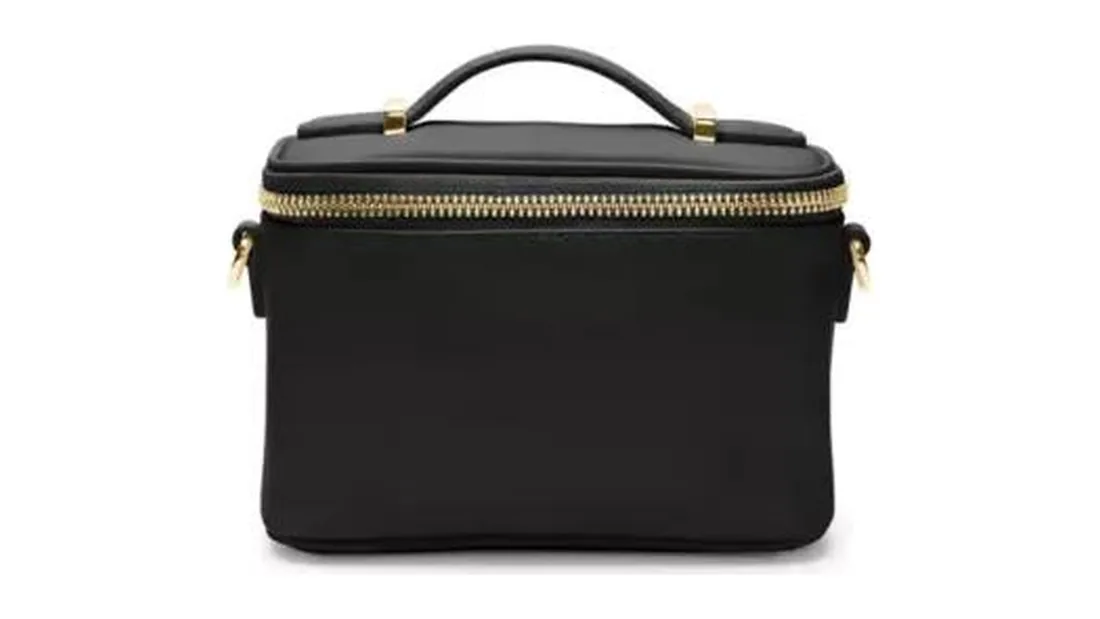
A boxy cosmetic bag holds its shape when it's empty. That single behavior separates it from a flat pouch. It's also the reason buyers choose one for brushes, bottles and anything that needs protection in transit. The shape doesn't come from the fabric. It comes from how the panels are cut, what's hidden between shell and lining, and how the base is joined to the sides.
This guide walks through the construction decisions that make a boxy cosmetic bag stand up, stay crisp and survive repeated use. It's written for sourcing managers and brand owners specifying a structured bag at volume. Not for someone sewing one at a kitchen table.
What "Boxy" Actually Means: A Structured Bag, Not Just a Squared-Off Pouch
Box construction is a panel arrangement that forms a rectangular three-dimensional cavity. Front, back, two sides, a bottom and a top closure. That's it. The panels meet at defined edges. The bag keeps that geometry whether it's full or empty.
A flat pouch is different. It's two panels sewn together, sometimes with a single gusset at the bottom. Load it and it bulges. Empty it and it collapses flat. Neither behavior is wrong; they're just different products.
A train case sits at the other end. It's a rigid shell, often molded or framed, with a hard exterior that doesn't flex. Protection is high. Packability is low. Say a buyer is sourcing for a travel brand and needs something that slides into a carry-on without wasting space: a boxy bag usually wins. A buyer who needs crush protection for glass bottles may want the train case instead. The middle ground is where most cosmetic bag programs live. Structured enough to protect, soft enough to pack.
How the Shape Is Held: Panel Stiffeners, Foam Backing and Interlining
Interlining is a hidden layer placed between shell and lining. It provides structure, padding or insulation. Its weight decides whether the bag slumps or stays crisp. Get this layer wrong and the bag looks tired after a month of use.
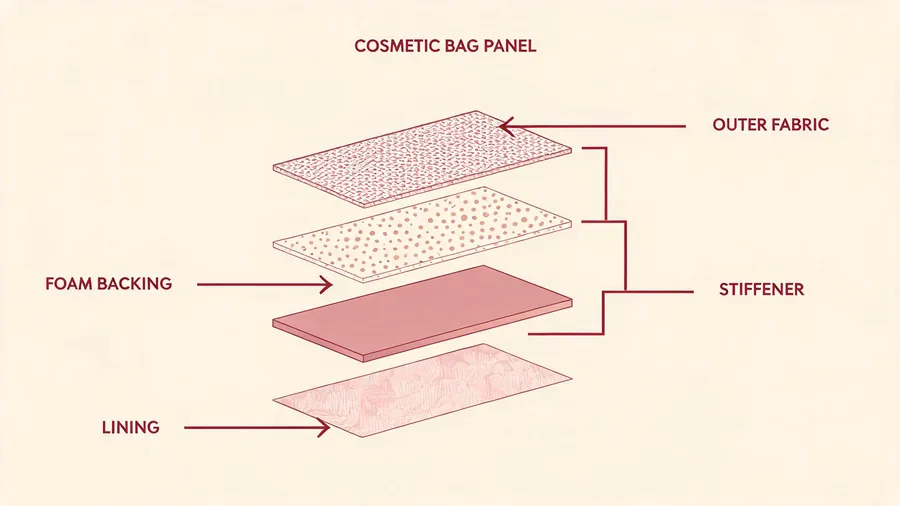
Foam or batting backing behind the front and side panels adds another dimension. A quilted panel behaves differently from a plain laminated one. Quilting creates small pockets of loft that resist compression and give the surface a soft hand. A laminated panel is flatter and more rigid but can feel boardy if the foam is too dense.
Edge details sharpen the silhouette. Piping inserts a corded or flat detail into the seam for shape, protection and appearance. Binding wraps a raw edge or seam allowance. Topstitch runs a visible line for reinforcement and edge control. A buyer who wants a crisp corner should ask what piping or binding is specified. A soft edge reads as a soft bag no matter how stiff the panel is.
Stiffener gauge and panel behavior
Panel stiffener gauge is set in the approved specification. It's one of the first things to confirm on a sample. Too light and the bag folds at the corners. Too heavy and the zipper fights the panel. The right gauge depends on shell weight, panel size and how the bag will be packed.
Base and Gusset Construction: Why the Bag Stands Up Empty
The bottom panel is the base. It's usually reinforced for abrasion and load support. How it's joined to the side panels determines whether the bag sits flat or rocks.
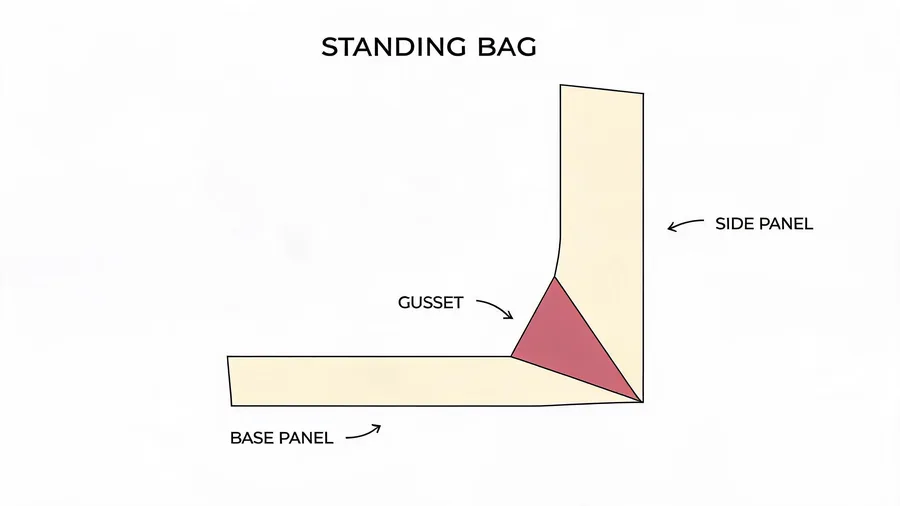
A gusset is a panel inserted to create depth, volume, expansion or shape. In a boxy bag, the gusset is what turns a flat pouch into a three-dimensional cavity. The difference between a boxed corner and a full gusset matters here. A boxed corner is a fold-and-stitch technique at the bottom of a two-panel body. A full gusset is a separate panel running the depth of the bag. Full gussets hold shape better under load. Boxed corners are lighter and cheaper to produce.
Here's a test any buyer can run. Stand the empty sample on a table. If it stays upright, the base and side panels were cut and stiffened correctly. If it slumps, the stiffener is too light or the base panel is under-reinforced. That's not a cosmetic issue. It's a sign the bag will deform in a warehouse carton.
Zip-Around or Top-Zip: Opening Style, Access and Hardware
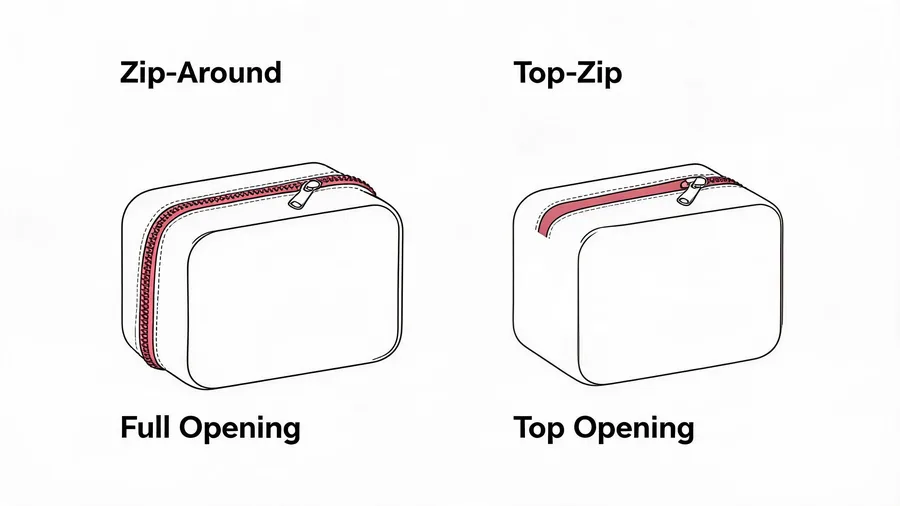
Zip-around and top-zip are not interchangeable. A zip-around opens the bag almost completely, with the slider traveling most of the perimeter. Visibility is high. Access is wide. A top-zip opens only the top edge. That keeps contents contained but limits how far you can see inside.
Zipper components are specified independently. The chain is the interlocking teeth or coils attached to textile tapes. The slider joins or separates the chain. The puller is the tab attached to the slider for hand operation. A buyer can mix and match these: a molded plastic slider on a coil chain, a metal slider on a nylon chain, a leather puller on either. Each combination changes feel, cost and durability.
Reinforcement at stress points is non-negotiable. Bar tack is a dense short stitch pattern used at high-stress points. Box-X stitch is a rectangular reinforcement with diagonal crossing lines, commonly used at webbing attachments. Both belong at handle roots, loop anchors and zip ends. Skip them and the bag fails at the exact points a user pulls hardest.
Handles, Carry Loops and Interior Organisation
Webbing handles and carry loops are narrow woven tapes used for straps, handles, reinforcement and attachment points. A D-ring is a D-shaped ring used as an attachment or routing point. A swivel hook is a rotating hook used on detachable straps. Together they let a buyer offer a wrist strap, a shoulder strap or both without changing the bag body.
Interior organisation is where a boxy bag earns its price. Elastic loops separate cylindrical containers, brushes and small tools. Mesh pockets provide visibility and drainage but offer limited liquid containment. Clear film pockets improve content identification and wipe-clean performance. A removable insert isolates spills and simplifies cleaning. Brush guards and protective flaps reduce contamination and keep bristles off other contents.
Imagine a buyer sourcing for a makeup artist brand. The spec calls for six elastic loops sized to standard brush handles, one mesh pocket for sponges and a clear film pocket for small palettes. That's a different interior from a travel kit meant for bottles. Same exterior box, different function.
Fabric and Finish Choices That Keep a Crisp Shape
Shell weight and weave interact with the stiffener. Heavier shells hold a crisp edge with less interlining. Lighter shells need more support. Nylon at 110, 160, 180, 220 and 240, 280 gsm covers base, 420D and 600D constructions. Polyester runs 190T, 210T, 300T, 600D and 1200D. Canvas comes in 8, 10, 12 and 15 oz. rPET is available for programs with recycled-content requirements.
Coated and laminated surfaces change cleanability. Cleanability depends on surface smoothness, seam construction, corner geometry and material compatibility with expected residues. A wipe-clean liner reduces absorption. Welded or sealed seams contain leaks better than ordinary stitched seams. A stitched bag may still use a removable waterproof insert when full seam sealing isn't necessary.
Three terms get used loosely. Wipe-clean lining is a smooth coated or film-based inner surface that can be cleaned with limited moisture. Leak-resistant construction delays liquid escape but isn't guaranteed liquid-tight under pressure or prolonged exposure. Leakproof construction is designed and tested to prevent liquid passage under stated test conditions. A buyer should specify which one the program actually needs. The cost difference is real.
Seam treatment matters for the inside of the bag. Turned construction inverts the assembly after stitching so seam allowances remain inside. Bound-seam construction covers internal seam allowances with binding. Bound seams look cleaner and resist fraying; turned seams are faster and lighter.
For a deeper look at how shell materials and coatings are specified across cosmetic bag programs, see the makeup bag materials guide.
What to Check on a Boxy Cosmetic Bag Sample
Pre-production samples are where construction problems show up. Check these before signing off.
- Corners after boxing. Sharp, symmetrical, no puckering or crushed stiffener. Run a thumb along each corner seam.
- Zip tension and slider feel. Pull the slider through the full travel. It should move smoothly without catching or binding at the corners.
- Puller attachment. Tug the puller firmly. It shouldn't rotate freely or show loose stitching.
- Zip-end finishing. Look for bar tack or Box-X reinforcement at both ends.
- Stand-up test. Place the empty bag on a flat surface. It should stay upright.
- Base reinforcement. Press the bottom panel. It should feel firm, not spongy.
- Interior loops and pockets. Check elastic tension, mesh attachment and clear film clarity.
- Lining seams. Confirm turned or bound construction matches the spec.
For programs that need a softer, flatter alternative to the boxy shape, the lay-flat cosmetic bag guide covers the other end of the structure spectrum.
Comparing flat pouch, boxy bag and train case
| Attribute | Flat pouch | Boxy bag | Train case |
|---|---|---|---|
| Structure | Two panels, sometimes one bottom gusset | Multi-panel box with stiffener and interlining | Rigid shell, molded or framed |
| Shape when empty | Collapses flat | Stands upright | Holds shape, no flex |
| Protection | Low, contents shift and compress | Moderate, panels cushion and hold position | High, resists crushing |
| Packability | High, folds into small spaces | Moderate, takes fixed volume | Low, bulky and heavy |
| Interior organisation | Limited, usually one compartment | Elastic loops, mesh and clear film pockets, removable insert | Trays, dividers, molded recesses |
| Typical use | Everyday carry, gym bag, quick touch-ups | Travel kits, brush sets, professional use | Salon, film and makeup artist transport |
| Opening style | Top-zip, sometimes none | Top-zip or zip-around | Lid with latch or zip-around |
If the program is a bulk order with multiple colorways and a fixed retail launch date, the bulk cosmetic bags buying guide covers the sourcing sequence.
Send a spec and a target quantity through the product pages and a quote will come back with construction options matched to the shape you need.
Frequently Asked Questions
What is a boxy bag?
A boxy bag is a structured bag built from multiple panels (front, back, two sides, bottom and a top closure) that form a rectangular three-dimensional cavity. It holds its shape when empty, unlike a flat pouch that collapses. The structure comes from panel geometry plus a hidden stiffener or interlining layer between the shell and lining.
What are the dimensions for a boxy makeup bag?
There's no single standard size. Dimensions depend on what the bag is meant to hold: a brush-focused bag needs length for handles, a bottle-focused bag needs height and a reinforced base. Buyers should specify dimensions based on the largest item in the kit plus clearance for the zipper and seam allowance. The exact figures belong in the approved specification, not in a general rule.
What is a boxy cosmetic bag with a zipper?
It's a structured cosmetic bag closed by a zipper, either top-zip (opening only the top edge) or zip-around (slider traveling most of the perimeter). Zipper components are specified independently: chain, slider and puller can each be chosen separately. Reinforcement at the zip ends, usually bar tack or Box-X stitch, prevents the most common failure point.
What should you check on a boxy cosmetic bag sample before ordering?
Check corner sharpness after boxing, zip tension and slider feel across the full travel, puller attachment strength, zip-end reinforcement, whether the empty bag stands upright, whether the base panel feels reinforced, elastic loop tension, and whether the lining uses turned or bound-seam construction. Each of these points reveals a construction decision that's hard to fix after production starts.