Lay Flat Cosmetic Bags: How the Wide-Open Design Is Built
What a lay-flat cosmetic bag actually is
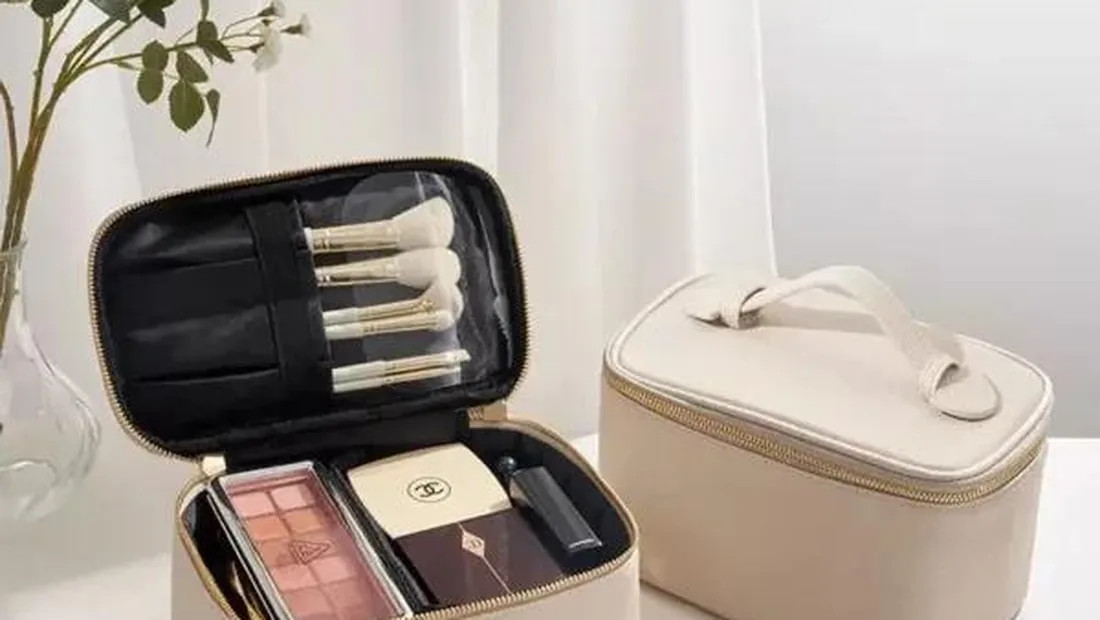
A lay flat cosmetic bag opens into a wide, flat mat. Every item stays visible. You don't dig through a dark pouch to find a lip liner. The bag uses a perimeter closure that runs around the edge, either a drawstring or a wraparound zipper. When the closure releases, the sides fold down and the bag becomes a tray.
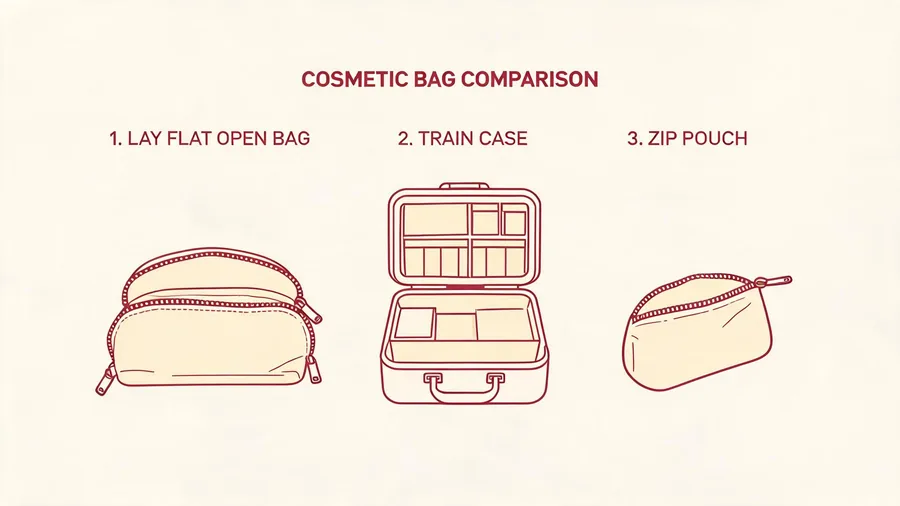
This is not a zip pouch. A zip pouch has a single top zipper and keeps its shape. A boxy train case has rigid or semi-rigid walls and opens like a small trunk. The lay-flat format sits between them: soft enough to pack flat, structured enough to hold its shape when open.
Buyers ask us why the design matters for retail. It matters because users see everything at once. That reduces the time spent searching and the chance of a product getting lost at the bottom. For a brand, it's a selling point you can show in one photo: the bag open, every product visible.
Closure systems compared: drawstring vs wraparound zipper
Two closure systems dominate. Each behaves differently on a sample and in daily use.
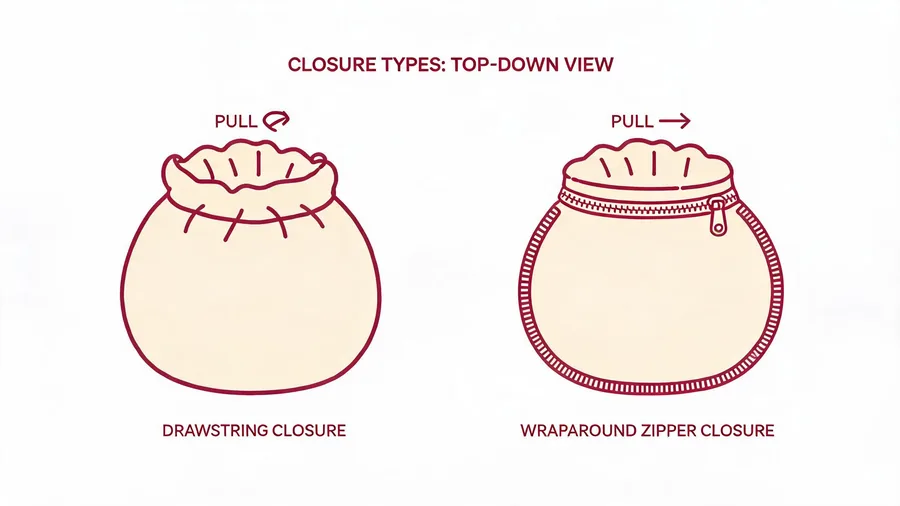
A perimeter drawstring uses a cord that runs through a channel around the top edge. Pull the cord, the bag cinches closed. Release it, the sides fall open. It's fast. One hand can do it. The downside is that the closed bag has a gathered opening, not a sealed edge. Dust and light moisture can get in. The edge also lacks rigidity, so the bag can look soft when closed.
A wraparound zipper runs around three sides of the bag. Open it fully and the top panel folds back like a lid. Close it and you get a cleaner, more secure edge. The zipper takes longer to operate than a drawstring. It also adds cost and sewing time. The hardware matters here. A drawstring needs a cord lock that holds tension without slipping. A wraparound zipper needs a slider that travels smoothly around the corners without catching on the seam allowance.
For a buyer, the choice comes down to the brand's positioning. If the bag is marketed as a quick-access travel organizer, the drawstring wins. If it's marketed as a protective case with a clean silhouette, the zipper wins.
Panel construction and stiffeners that keep the mat flat
A lay-flat bag is built from several panels. The main compartment is the largest enclosed area. The front panel faces outward. The back panel faces the user. Side panels and a bottom panel give the bag depth. A gusset is the panel inserted to create that depth. On a lay-flat bag, the gusset is often the part that folds down when the bag opens.
The flat-open behavior depends on how these panels are sewn. Box construction forms a rectangular cavity. Darts create curvature. Seam allowance controls how the panels meet at the corners. If the seam allowance is too wide or the notches are misaligned, the bag won't lie flat. It will bunch at the corners.
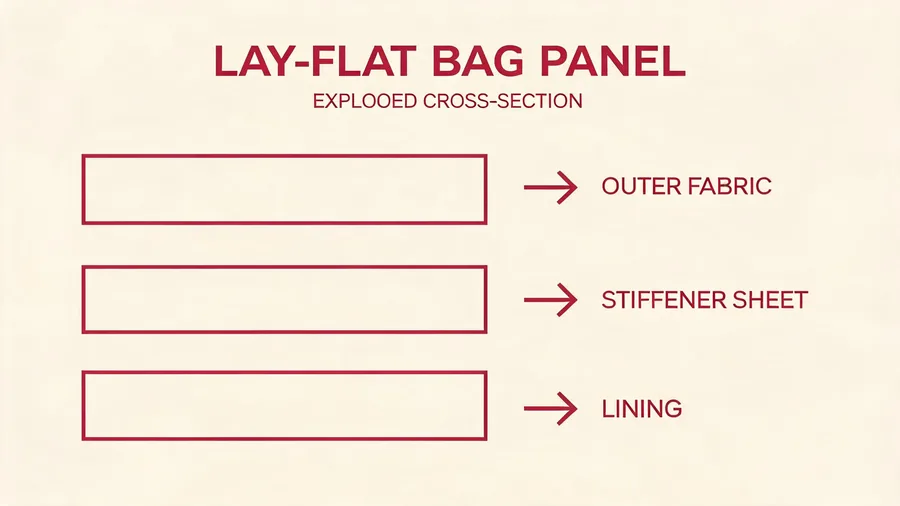
Stiffeners keep the mat flat without making the bag bulky. A thin interlining layer sits between the shell and the lining. It adds structure. It also gives the bag a slight memory, so it holds its shape when open. The interlining can be a light foam, a stiffened nonwoven, or a laminated fabric. The choice depends on the shell fabric and the target price.
High-stress points need reinforcement. Bar tack is a dense short stitch pattern used at corners and cord exits. Box-X stitch is a rectangular reinforcement with diagonal crossing lines, common at webbing attachments. These aren't decorative. They're what keeps the bag from tearing after repeated open-close cycles.
Fabric choices: quilted nylon, waterproof polyester and PU
Fabric choice affects the look, the weight, and the cleanability. Nylon weights commonly run from about 110 g/㎡ for lightweight bags to 280 g/㎡ for heavier, more structured ones. Denier options like 420D and 600D sit in the middle. These are widely available in our supplier network. Quilted nylon adds a soft, padded look and hides minor wrinkles.
Polyester options range from 190T to 1200D. A PU or PVC coating is often specified for water resistance. A coating rated at 3000 mm or higher is typically specified for splash protection and light spills. For full waterproofing, TPU lamination at 10,000 mm or higher is the stronger option. Heat-welded seams and waterproof zippers complete the leak control.
The lining matters as much as the shell. A wipe-clean liner reduces absorption. It's a smooth coated or film-based inner surface. If the bag uses ordinary stitched seams, a removable waterproof insert can isolate spills. That's a practical compromise when full seam sealing is unnecessary.
Interior organization: pockets, elastic loops and removable inserts
Organization turns a flat mat into a working surface. Elastic loops separate cylindrical containers, brushes, and small tools. The loop tension needs to be firm enough to hold a brush, but loose enough to release it without a fight.
Mesh pockets provide visibility and drainage. They're good for items that need to air out. Clear film pockets improve content identification and wipe-clean performance. A buyer ordering 800 units in three colors might spec mesh on one side and clear film on the other.
A removable pouch supports cleaning and allows wet or spill-prone items to be isolated. A hanging hook requires reinforcement because the complete load is concentrated at one attachment point. Brush guards and protective flaps reduce contamination. They keep bristles from touching other contents.
Lay-flat bag vs train case vs zip pouch
| Format | Openness | Protection | Capacity | Typical use |
|---|---|---|---|---|
| Lay-flat bag | High, full visibility | Low to medium, soft walls | Medium, flat pack | Daily makeup, travel tray |
| Train case | Medium, top access | High, structured walls | High, deep storage | Pro kits, long trips |
| Zip pouch | Low, single opening | Medium, soft but closed | Low to medium | Minimal kits, accessories |
When a lay-flat bag is right for a buyer's range: the brand sells quick visual access, the product photos show the bag open, and the target user travels with a curated set. When a train case or zip pouch still works better: the user needs crush protection, or the brand wants a lower-cost simple silhouette.
What to check on a sample before bulk production
Start with the drawstring travel. Pull the cord all the way out. The bag should open fully and the mat should lie flat without curling at the corners. If it doesn't, the gusset or the seam allowance is wrong.
Check the zipper wrap length on a wraparound zipper. It should run far enough around the perimeter that the top panel folds back completely. A short zipper leaves a lip that blocks access.
Pocket placement matters. Elastic loops should hold a standard brush without sagging. Mesh pockets should not be so shallow that items fall out when the bag is carried. Clear film pockets should be easy to wipe.
Leak-resistant versus leakproof is a common confusion. Leak-resistant construction delays liquid escape but is not guaranteed to remain liquid-tight under pressure. Leakproof construction is designed and tested to prevent liquid passage under stated test conditions. Ask any supplier what test conditions they use. If they can't name them, the bag is probably leak-resistant, not leakproof.
What to specify for a bulk lay-flat bag order
For makeup bags generally, our MOQ is 500 pcs. Lay-flat bags are a specialized construction, so contact us for the specific MOQ. Sampling lead time is 1 to 10 days, depending on the design. Production lead time for cosmetic and toiletry bags typically runs 7 to 15 days for full custom orders, though complex structures can extend that.
Specify the fabric weight, the closure type, the pocket layout, and the logo process. Logo methods for this category include woven labels, metal plates, heat-pressed PVC, and laser engraving. Each has its own minimum order quantity. Confirm the placement before sampling. A logo on the bottom panel disappears when the bag is open. A logo on the front panel stays visible.
For more on materials, see our makeup bag materials guide. For lining options, read cosmetic bag linings explained. If you're ready to discuss a custom run, contact us with your target spec.
Frequently Asked Questions
What are the benefits of a lay flat makeup bag?
The main benefit is visibility. Everything sits on one open surface, so you don't dig through a dark pouch. It also packs flat in luggage and doubles as a tray on a hotel counter. For brands, it's a format that photographs well open.
Which flat lay makeup bag is the best?
There's no single best bag. The right choice depends on the closure system, the stiffener, and the fabric. A wraparound zipper gives a cleaner edge. A drawstring opens faster. Check the sample for how flat the mat lies and how the pockets hold tension.
What is the viral makeup bag?
The viral format is the drawstring or wraparound lay-flat bag that opens into a full mat. It spreads on social media because the open state is visually striking. The design itself is not new, but the flat-open behavior is what makes it shareable.
What should I check before ordering lay flat cosmetic bags in bulk?
Check the closure travel, the mat flatness, the pocket tension, and the seam reinforcement at corners. Ask the supplier whether the bag is leak-resistant or leakproof and what test conditions they use. Confirm the MOQ and logo placement before sampling.