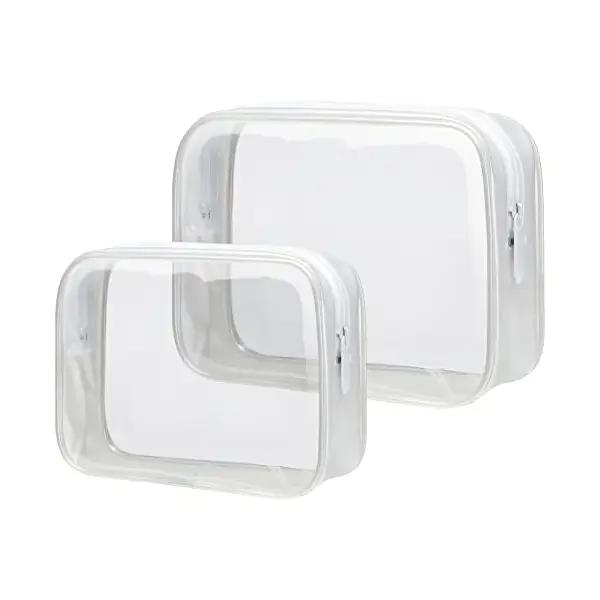
CB-4627 · Makeup Bag
TSA Approved Quart Size Toiletry Bag
- MaterialSafe PVC Plastic, 0.3 mm
- Dimensions7.5 x 5.9 x 2.2 inch
- ColorCustomized Made
- Custom LogoAccept Customized Logo
Lead time
| Quantity | Production time |
|---|---|
| 1-200 pieces | 25 days |
| 201-500 pieces | 30 days |
| > 500 pieces | To be negotiated |
Paid sample in 1-10 days. 24-hour response on every inquiry.
Why buyers pick this style
- Sized for the TSA 3-1-1 liquids rule. The medium clear bag measures 7.5 x 2.2 x 5.5 inches for quick airport security screening. The large size (9.6 x 3.1 x 6.5 inches) exceeds the TSA-approved size for liquids and suits general kit duty.
- 0.3 mm PVC, not giveaway plastic. Reinforced with heat-sealed and metal closures to withstand travel wear, and reusable trip after trip.
- Holds its shape. Reinforced boning keeps the bag standing, a smooth metal zipper opens wide, and the whole bag weighs just 0.7 lbs.
- Easy to live with. Wipe with a damp cloth and air dry. Suitable for travel, camping or gym use, ages 12 and above.
This is the product behind our TSA quart size bag dimensions guide, the most-read page on this site. Private label programs start at 200 pieces on this style.
Ready to sample your cosmetic bag line?
Send your brief and reference photos. Paid samples in 1-10 days, revisions in 2-3 days.
What this construction is good at, and where it is the wrong choice
If you are sourcing a quart size toiletry bag, the published material and dimensions already tell you a lot about the product's ceiling and its floor. This SPU uses 0.3 mm PVC. That is a thin, wipe-clean shell, not a padded case. It will shrug off a damp bathroom counter and a leaking shampoo cap. It will not hide dents if someone steps on it, and it will not feel premium in the hand the way a coated canvas or a thicker synthetic leather would.
At 7.5 x 5.9 x 2.2 inch, the bag is compact enough for a carry-on pouch but shallow enough that a full-size hairbrush or a chunky pump bottle will fight the zipper. The shape works best for flat and small items: tubes, travel jars, disposable razors, a folded washcloth. Buyers who sell this as a gym or camping accessory should expect the same geometry to serve that use, because the dimensions do not change when the audience does.
| Published spec | What it means in use | What to watch for |
|---|---|---|
| Safe PVC Plastic, 0.3 mm | Lightweight, wipe-clean, and low-cost, but with limited puncture resistance and a plasticky hand feel. | Confirm the plasticizer smell and surface tack; these vary by PVC compound even at the same thickness. |
| Dimensions 7.5 x 5.9 x 2.2 inch | Fits flat toiletries and small containers; shallow depth limits bulky items. | Check the zipper path around the top edge, because the tight radius can bind on a stiff PVC panel. |
| Color Customized Made | Brand colors are possible across the shell. | Confirm color matching against a physical swatch, not a screen, before sampling. |
| Custom Logo Accept Customized Logo | The bag can carry a buyer's mark. | Ask which logo methods survive the heat-sealed construction without distorting the PVC. |
| Reinforced with heat-sealed and metal closures | Seams and closures are built to take repeated opening and packing. | Inspect the seal width and the metal closure finish; these are the first points to fail in a travel bag. |
| Reinforced boning keeps the bag standing | The bag holds its shape when empty and on a shelf. | Boning can crease if the bag is folded flat for shipping; specify packaging that prevents a permanent fold. |
| Weighs just 0.7 lbs | Low weight supports travel and retail shipping economics. | Do not confuse light weight with flimsiness; the structure comes from boning, not from material heft. |
This is not the bag for a buyer who wants a soft, crushable pouch that disappears into a suitcase. The boning that keeps it standing also makes it less forgiving when overpacked. Say a buyer plans to sell it as a rigid countertop organizer. That works. Say another buyer wants it to collapse flat inside a weekender bag. That buyer will be disappointed, because the same reinforcement that creates the shape resists being flattened.
How buyers customize this SPU, and what each change does to tooling, cost or lead time
Most customization on this style is routine. Color changes, logo placement, and packaging choices do not require new tooling. The PVC is cut and heat-sealed from sheet stock, so a new color is a material swap, not a mold change. A buyer who already has a Pantone reference can send it with the brief, and the factory confirms the match against the approved specification. Pantone matching is part of the process, but the tolerance is fixed in the approved sample, not guessed from memory.
Logo methods split into two groups. A heat-pressed PVC logo or a printed mark sits on the surface and usually needs no structural change. A woven label or a metal badge adds a component and a sewing or riveting step, which can push lead time. Buyers sometimes ask for a debossed logo in the PVC itself. That requires a new die, so it belongs in the longer-runway category. The same is true for any change to the boning channel or the closure type.
Changes that touch the heat-sealed seam are the expensive ones. If a buyer wants a different zipper curve, a wider opening, or an extra internal pocket, the cutting pattern changes. That is a development task, not a color swap. It will affect sampling time and should be locked before the first sample, not after. Private label programs on this style start at 200 pieces, so the economics favor buyers who can commit to a single approved version rather than iterating through three pattern changes.
What to confirm before you approve sampling on this product
The points that cause the most rework on a PVC toiletry bag are smell, stiffness, zipper smoothness, and the fold line from packaging. None of these show up fully in a photo. A buyer should request a physical sample and open it in a warm room, because PVC odor and surface tack are temperature-sensitive. If the sample arrives folded flat, unpack it and let it rest. A crease in the boning channel will not always relax on its own.
Write these checks into the approved sample: the seal width at the corners, the metal closure's pull force, the color match under daylight and retail lighting, and the logo's adhesion after a wipe with a damp cloth. The factory can confirm these points against the approved specification. Ask for the sample to be packed the same way the bulk order will ship. That sounds obvious. It is the step most buyers skip, and it is the step that catches the bent boning and the crushed corners before they reach a customer.
For more on sizing, see our quart size bag dimensions guide. If you are comparing materials across a wider range, the makeup bag materials guide explains how PVC behaves next to coated polyester and canvas. And when you are ready to brief this SPU, start at contact.