Clear PVC Makeup Bags, Security-Line Friendly
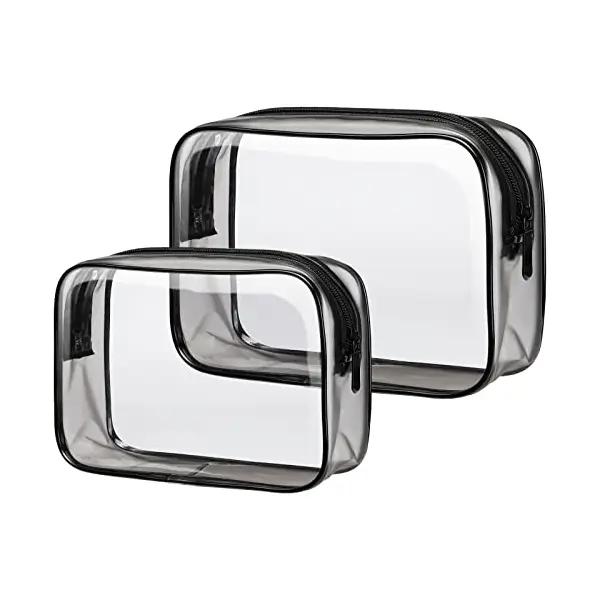
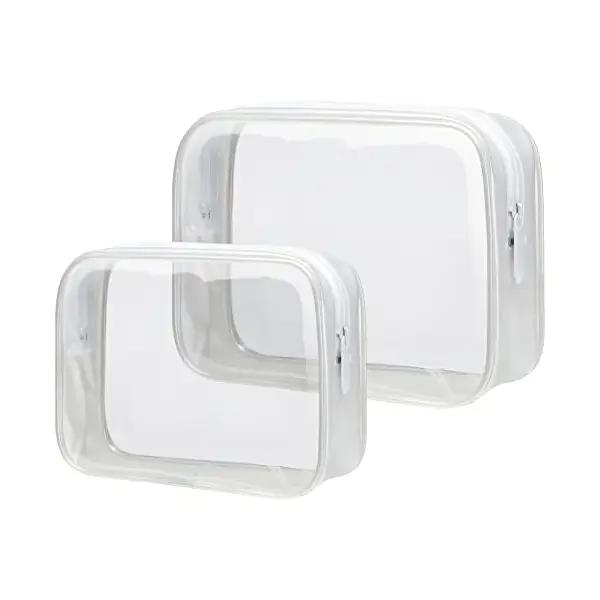
Transparent, wipe-clean and airport-security friendly. Our clear range is anchored by the CB-4627 TSA quart size bag.
Built thicker than the giveaway version
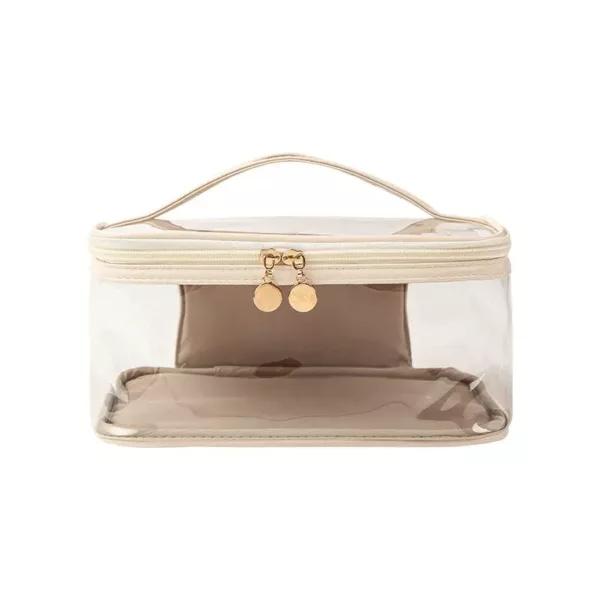
Our clear PVC makeup bags are cut from 0.3 mm PVC on styles like the CB-4627, reinforced with boning to hold shape and closed with metal zippers. Heat-sealed construction keeps seams tidy and watertight in a wet washbag.
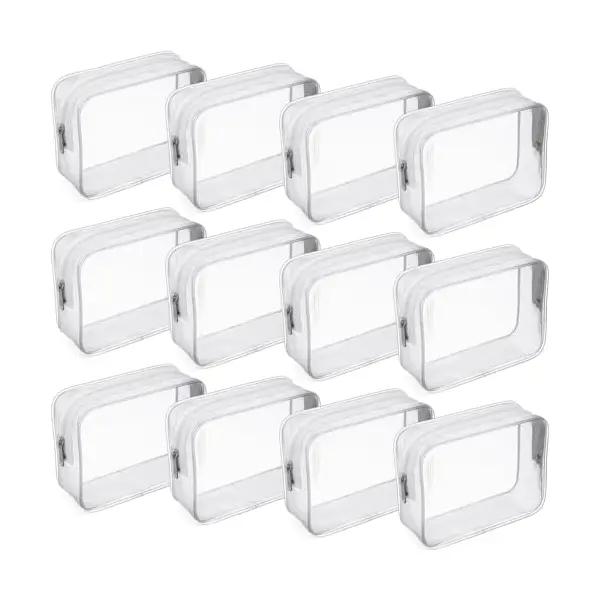
The hero of the range is the TSA-friendly quart size: the CB-4627 measures 7.5 x 5.9 x 2.2 inches to suit the TSA 3-1-1 liquids rule, and it is the product our TSA quart size guide is built around. For counter sets and holiday packs, the CB-4563 ships as a 12-piece clear set.
All clear styles accept custom logos, from heat-pressed PVC marks to metal plates. MOQ 500 pieces; samples in 1-10 days.
Buying questions, answered
Is clear PVC durable enough for daily use?
The CB-4627 uses 0.3 mm PVC with reinforced boning and metal closures, noticeably more robust than typical giveaway plastic bags, and it wipes clean with a damp cloth.
Are your clear bags TSA approved?
The CB-4627 medium size measures 7.5 x 2.2 x 5.5 inches, sized to suit the TSA 3-1-1 liquids rule for carry-on liquids. The large size exceeds the quart guideline and suits checked or general use.
Can we print our logo on clear PVC?
Yes. Heat-pressed PVC logos start around 500 pieces and metal plates around 200 pieces; both work well on transparent panels.
Ready to sample your cosmetic bag line?
Send your brief and reference photos. Paid samples in 1-10 days, revisions in 2-3 days.
Clear PVC Makeup Bag Materials and Construction Options
A clear pvc makeup bag looks simple from the outside. The construction decisions underneath determine whether it lasts one season or five. Most buyers start with the transparent panel and work outward from there. The film itself is rarely the problem. The seams, the zipper, and the way the clear film meets the textile frame are where failures happen.
Clear film used in cosmetic bags is almost always a polymer sheet, commonly PVC, TPU, or EVA. Each behaves differently under cold, heat, repeated folding, and contact with oils and solvents. A buyer who only specifies "clear front" has not yet specified a product. The film thickness, the welding method, and the edge treatment all change the quote.
| Material | Good for | Where it fails |
|---|---|---|
| PVC film | High clarity, low cost, stiff structure, easy to wipe clean | Can stiffen in cold, plasticizer migration over time, not a premium feel |
| TPU film | Flexible at low temperatures, weldable, abrasion resistant | Higher cost, can feel slightly tacky, scratches more visibly than PVC |
| EVA film | Soft, good low-temperature flexibility, cleanable liner | Lower clarity than PVC, can haze with repeated folding |
| PET film | Dimensional stability, crisp clarity, good print surface | Creases permanently, noisy, less suitable for high-flex zones |
The transparent panel rarely stands alone. It is welded or sewn into a textile frame, and that junction is the first point of inspection. A sewn-in clear panel needs a reinforcement tape or a folded edge. Without it, the needle holes become tear points. A welded panel avoids needle holes entirely but requires the film and the textile to be compatible at the bonding temperature. Say a buyer wants a clear front with a polyester back panel. The factory must test whether the PVC welds to the polyester coating or whether the seam needs a separate binding.
Cleanability is another construction variable. The reference material describes three levels: wipe-clean, leak-resistant, and leakproof. A wipe-clean lining is a smooth coated or film-based inner surface that tolerates limited moisture. Leak-resistant construction delays liquid escape but is not guaranteed under pressure. Leakproof construction is designed and tested to prevent liquid passage under stated conditions. Most clear pvc makeup bags fall into the first two categories. Claiming leakproof requires a documented test, not a confident description.
How Buyers in Different Situations Should Specify This Product
A buyer stocking airport convenience stores has a different problem from a buyer building a premium beauty brand. The same clear pvc makeup bag cannot serve both without specification changes. Here are three situations that show where the decisions actually change the outcome.
The TSA-focused travel buyer. This buyer needs a bag that passes through security checkpoints without slowing the traveler down. The clear panel must be genuinely transparent, not frosted or tinted. The zipper must open wide enough to show contents without removing every item. The reference material notes that a wide opening improves visibility and reduces the need to remove every item. Elastic loops and mesh pockets help separate brushes from liquids, but mesh offers limited liquid containment. A buyer in this situation should specify a clear film front, a wide U-shaped opening, and a hanging hook with reinforcement. The hook carries the complete load at one attachment point, so the reinforcement patch is not optional.
The cosmetic brand buyer. This buyer is putting a logo on a bag that will sit on a vanity or a store shelf. Clarity matters because the product inside is part of the display. The film must not haze after repeated folding or exposure to hand creams and oils. TPU resists plasticizer migration better than PVC, but it costs more. The buyer who wants a premium feel might choose TPU with a matte textile back panel. The buyer who wants a promotional giveaway might choose PVC with a simple zipper. Both are valid, but the quote and the tooling differ. A logo on a clear panel often uses a different process than a logo on fabric. The buyer should ask whether the logo goes on the film, the frame, or both.
The subscription box or gift-with-purchase buyer. This buyer cares about unit cost, packability, and unboxing feel. The bag ships flat inside another box, so it must fold without creasing permanently. EVA folds more gracefully than PET, but PET holds a crisper shape on a shelf. The buyer must decide which matters more. A removable pouch inside the clear bag can isolate wet items and simplify cleaning, which is a feature that reads well in a subscription context. The buyer should also specify the fold pattern for packing. A bag that arrives with a permanent crease across the clear front looks defective, even if it functions fine.
These three situations share one rule: the specification must match the use case. A buyer who copies a competitor's spec sheet without understanding why the competitor chose those values will inherit the competitor's compromises.
Customization That Changes Tooling, Cost, or Lead Time
Not all customization is equal. Some changes are free at the quote stage. Others require new dies, new molds, or a longer production window. Buyers who understand the difference can make faster decisions.
Changes that do not change tooling. Color of the textile frame, zipper color, printed logo on the fabric, and the choice of clear film thickness within a standard range. These are specification changes, not tooling changes. The factory adjusts the cutting and sewing instructions. Lead time stays roughly the same. The buyer can also change the internal organization, such as adding a mesh pocket or an elastic loop, without new tooling. These are sewing operations, not molded parts.
Changes that change tooling. A custom-shaped clear panel is the biggest one. If the buyer wants a curved or contoured window instead of a rectangular one, the factory needs a new cutting die. A custom zipper pull with a molded logo requires a new mold. A heat-welded logo on the PVC film requires a new embossing die. Any of these adds tooling cost and extends lead time. The buyer should ask the factory to separate tooling cost from unit cost in the quote. That way, the buyer can evaluate whether the tooling amortizes across the order quantity.
Changes that change cost but not tooling. Switching from a sewn-in clear panel to a fully welded construction. This changes the production method, not the die. Welded seams require different equipment and slower cycle times. The unit cost goes up, but the tooling may not. The buyer should ask whether the factory welds in-house or outsources. An outsourced welding step adds transit time and coordination risk.
One honest note: a buyer who wants a clear pvc makeup bag with a custom-shaped window and a welded logo and a molded zipper pull is buying three tooling changes at once. The quote will reflect that. The buyer who can live with a rectangular window, a printed logo, and a standard zipper pull keeps the project simple and the lead time short.
What to Check Before Approving Production
Approving a pre-production sample is not the same as approving a production run. The buyer should check specific things on the sample, then confirm them again on the first production pieces.
First, check the clarity of the film. Hold the bag up to a light source. Look for haze, scratches, or uneven thickness. The reference material notes that colorfastness is resistance to color change or transfer during rubbing, washing, light exposure, or contact with moisture. For a clear panel, the equivalent concern is whether the film yellows or hazes over time. The buyer should ask the factory for the film's aging performance under UV exposure. If the factory cannot provide a number, the buyer should state the expected shelf life and ask for a written confirmation.
Second, check the seam integrity. Pull on the seam where the clear film meets the textile frame. The needle holes should not elongate. The film should not tear at the stitch line. If the seam is welded, check for consistent bonding width. A weld that is too narrow will peel. A weld that is too wide will stiffen the edge and crack when folded.
Third, check the zipper function. Open and close it ten times. The zipper should not catch on the clear film. The slider should not scratch the panel. If the bag has a hanging hook, check the reinforcement patch. The reference material is explicit: a hanging hook requires reinforcement because the complete load is concentrated at one attachment point.
Fourth, control your performance claims. If the buyer plans to market the bag as leakproof, the factory must test it under stated conditions. A leak-resistant bag is not a leakproof bag. The reference material distinguishes the two clearly. A buyer who writes "leakproof" on the packaging without a test is taking a legal risk. The factory can help, but the buyer owns the claim.
Finally, check the fold pattern for shipping. Fold the sample the way it will be packed. Unfold it. Look for permanent creases in the clear panel. If the crease does not relax, the buyer should change the fold pattern or add a protective insert. A clear pvc makeup bag that arrives creased looks used, even when it is brand new. For more on material selection across bag types, see our makeup bag materials guide. Buyers comparing clear panel options may also want to review our clear PVC toiletry pouch or the wholesale makeup pouches range.