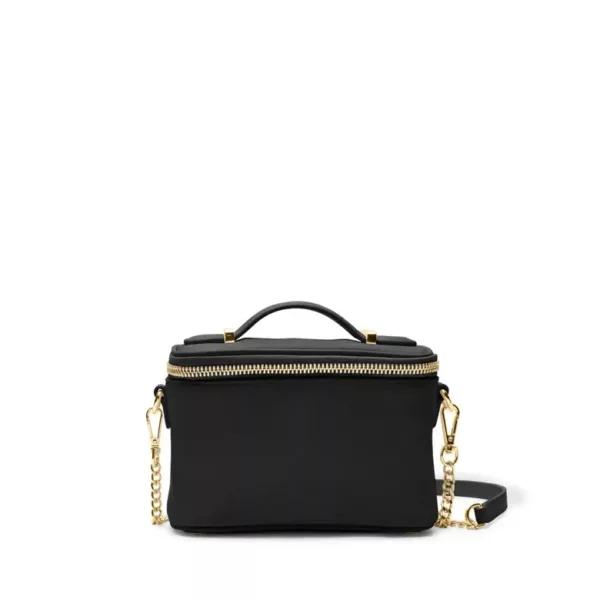
MB-5863 · Makeup Bag
Train Case Crossbody
- MaterialFull grain leather, Light gold hardware
- Dimensions6.5"W x 3"D x 4"H; strap drop 22"
- ColorCustomized Made
- Custom LogoAccept Customized Logo
Paid sample in 1-10 days. 24-hour response on every inquiry.
Why buyers pick this style
- Full grain leather body. The bag measures 6.5”W x 3”D x 4”H with a 22” strap drop. Light gold hardware adds a clean finish that works for retail and boutique lines.
- Detachable chain strap. The nickel-free chain comes with a leather shoulder pad detail. It's easy to swap or remove when your customers want a top-handle carry.
- Four card slots inside. The interior also includes two open pockets and two zip pockets. Everyday essentials stay organized without adding bulk.
- YKK zip-around closure. The metal zipper opens wide for quick access. Metal feet at the base protect the leather when the case is set down.
- Ready for personalization. This SKU supports custom options. Ask about logo placement, hardware finishes, or packaging choices for your order.
A compact train case that doubles as a crossbody. We build it in full grain leather with light gold hardware and a detachable nickel-free chain strap. The inside keeps things simple: four card slots, two open pockets, and two zip pockets. It's a practical shape for buyers who want a small leather piece with room for branding.
Ready to sample your cosmetic bag line?
Send your brief and reference photos. Paid samples in 1-10 days, revisions in 2-3 days.
Train Case Crossbody: What the Construction Does Well, and Where It Fights You
The Train Case Crossbody is built around a full grain leather body. That single choice sets the tone for everything else. Full grain leather is the hide's top layer, left intact rather than sanded. It keeps the natural grain, which means each bag carries a slightly different surface story. Buyers who want a uniform, mass-produced look will find that annoying. Buyers who want a leather piece that ages and marks like leather will see it as the point. A compact train case that doubles as a crossbody works because the structured base keeps the shape while the strap frees the hands. The trade-off is interior space. At 6.5"W x 3"D x 4"H, this is not a catch-all. It is a curated carry. The depth is the limiting factor. Three inches holds a phone, a slim wallet, keys, and a lip product. It does not hold a full-size brush roll or a chunky card case. Say a buyer orders this for a boutique line of evening bags. The size reads as intentional. Say a buyer tries to position it as a daily workhorse. The size will disappoint.
| Published spec | What it means in use | What to watch for |
|---|---|---|
| Full grain leather | Surface character varies from hide to hide; scratches and creases become part of the patina rather than defects. | Color consistency across a large order. Natural grain soaks up dye unevenly, so batch-to-batch tone shifts are real. |
| Light gold hardware | A warm metallic finish that reads more boutique than bright brass. It sits quietly against most leather colors. | Plating wear on high-contact points like the zipper pull and the chain clips. Ask for a finish sample before bulk. |
| 6.5"W x 3"D x 4"H | A structured, small-footprint case that holds a phone, slim wallet, keys, and a few cosmetics. The height gives it train-case presence without bulk. | Depth is the squeeze point. If your customer carries a bulky card case or a full-size brush, the zipper will strain. |
| Strap drop 22" | Sits at the hip on most wearers as a crossbody. The drop is fixed, so the fit is the fit. | No adjustability. A buyer who is tall or wears thick coats will find the bag sits higher than expected. |
| Detachable chain strap | Switches the carry from crossbody to top-handle. The chain adds weight and a jewelry-like feel. | Chain link finish and the attachment hardware. A weak clip is the first thing to fail on a loaded bag. |
This is a piece for buyers who want a small leather object with room for branding, not a utility organizer. If your program needs a wipe-clean interior for spilled foundation or a wide opening for brush access, this shape is the wrong tool. The full grain leather body asks for a customer who treats the bag as an accessory, not a sponge.
How Buyers Customize This SPU, and What Each Change Does to Tooling, Cost, and Lead Time
Most customization on this product is routine. A buyer who changes the leather color, the hardware finish, or the logo placement is not asking for new tooling. The bag is built on existing patterns. What changes is the cutting ticket and the finishing line. Pantone matching for the leather is typically specified to a ΔE tolerance, and a buyer who wants a tight match should expect to approve a lab dip before cutting. Say you want a debossed logo on the front panel. That uses a heated die and pressure. The die itself is a tooling cost, but the production line does not change. Lead time stays inside the standard sampling window. Say you want a metal logo plate instead. That is a separate component with its own die and attachment step. It adds a few days to sourcing, not weeks.
The changes that need a longer runway are structural. A buyer who asks for a wider base, a taller body, or an added exterior pocket is asking for a new pattern. That means a new cutting die for the leather panels, and possibly a new stiffener for the base. The factory can do it, but the sample is no longer a colorway sample. It is a development sample. A buyer who wants to change the strap drop from 22" to something adjustable is asking for a different strap system. That means new hardware, new webbing or chain length, and new attachment points. The leather shoulder pad detail also has to be re-scaled. These are not impossible. They just move the project from sampling into pattern work.
Packaging is the quiet lever. The PUBLISHED SPEC block says the SKU supports custom options. A buyer who wants a branded dust bag or a custom hang tag is adding a packaging step, not a product step. That can run parallel to production. A buyer who wants a full gift box with a foam insert is adding a packaging tooling item. The insert has to be die-cut to fit this exact 6.5"W x 3"D x 4"H body. That is a new die and a longer packaging lead time. Ask about it early, not after the leather is cut.
What to Confirm Before You Approve Sampling on This Product
The points that cause the most rework on a small structured leather case are the ones that look simple on a drawing. Confirm the interior layout first. Four card slots, two open pockets, and two zip pockets sounds generous until the bag is in hand. The depth is only three inches. If the card slots are too tight or the zip pockets are too shallow, the whole interior feels cramped. Specify the slot opening width and the pocket depth in the approved sample. Do not leave it to the pattern maker's judgment.
Confirm the zipper behavior. The YKK zip-around closure opens wide, but the curve of the case matters. A zipper that runs around a tight corner will catch if the leather is too stiff or the seam allowance is uneven. Ask for a video of the zipper being opened and closed on the actual sample, not a stock clip. Then confirm the strap attachment. The detachable chain strap carries the full load at two clip points. A buyer who sends reference photos of a similar bag but does not specify the clip type will get the factory default. That default may be fine. It may also be the weakest link. Specify the clip style, the finish, and the pull test expectation in the sample notes.
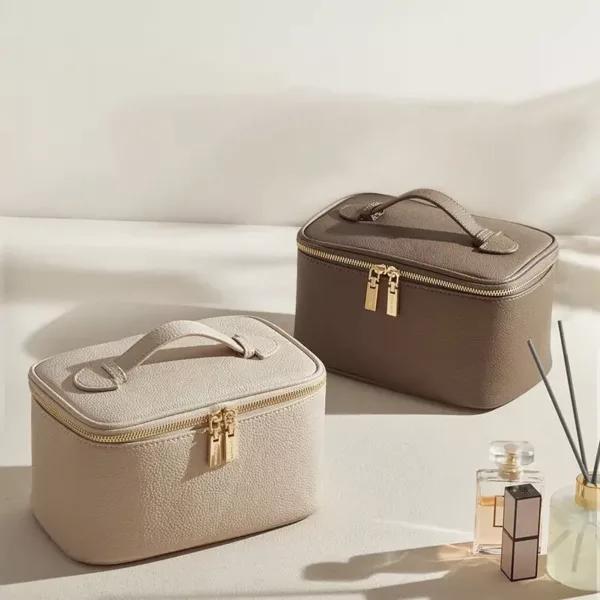
Finally, confirm the leather temper and color tolerance. Full grain leather can be soft or firm depending on the tannery. A soft temper will slouch. A firm temper will hold the train-case shape. The photos on the page show a structured case. If you want that structure, write it down. Ask for the temper to be specified as firm or semi-firm, and approve a physical swatch before the sample is cut. Color is the same story. Natural grain leather takes dye unevenly. A buyer who approves a digital render but never a swatch will be surprised by the first production run. The time to catch that is before sampling, not after. We cover more on how to structure a custom order on our custom cosmetic pouch page, and our about page explains how we handle sampling and approvals. If you are comparing this to softer pouch shapes, the makeup pouches wholesale page shows the range.