Men's Leather Cosmetic Bags: Grades, Linings, Sourcing
A men's leather cosmetic bag is not one product. It's a decision about leather grade, lining, structure, hardware, and logo process. Buyers who develop a leather mens cosmetic bag for private label often start with the leather. Every other decision hangs on it. No, that's not a formality. The leather sets the price band, the hand feel, the aging behavior, and the decoration options.
We make cosmetic bags and toiletry kits at a BSCI-certified factory in Yiwu, Zhejiang. Since 2013, we've worked with brands on dopp kits, hanging kits, and framed cosmetic cases. This guide covers what sourcing managers actually need to specify before sampling.
Leather grades and finishes: what changes as the bag ages
Full grain leather is the top surface of the hide with nothing sanded away. It keeps the natural grain, scars, and pores. Over time it develops a patina, a soft sheen where the bag is handled most. It darkens unevenly. Some buyers want that. Others don't. Full grain also softens and flexes with use, which is why it's common in higher-priced men's toiletry bags.
Top grain leather is sanded lightly to remove surface marks. The result is more uniform. It still ages, but the change is less dramatic than full grain. It takes color more evenly, which matters for a brand that needs consistent product photos across a full production run. A buyer ordering 800 units in three colors will notice color variation faster than a buyer ordering 50.
PU leather and synthetic leather are coated composites, usually polyurethane or polyvinyl chloride on a textile backing. They don't develop patina. They stay the same color and surface for years, until the coating cracks or peels. For a brand selling at a lower price point, that consistency is a selling point, not a flaw. Vegan leather alternatives behave the same way. The surface is stable, but the hand feel is different from natural leather and the edge finish is a bigger factor in perceived quality.
Temper matters more than most buyers expect. Temper is the relative softness or firmness of the leather. A soft temper drapes and folds easily. A firm temper holds a structured shape. For a men's toiletry bag, a medium to firm temper usually works better because the bag sits open on a counter. A bag that collapses into a puddle is annoying. Thickness and surface consistency also matter. A brand that sells online will get returns if one unit feels thinner than the photo suggests.
Leather grade versus feel, durability, price band, and logo process
The table below is a working comparison. Price bands are qualitative because real pricing depends on quantity, hardware, and construction. Use it to start a conversation with a factory, not to quote a customer.
| Leather grade | Hand feel | Durability | Price band | Suitable logo process |
|---|---|---|---|---|
| Full grain | Natural, softens with use, visible grain | High; surface marks blend into patina | Highest | Debossing, embossing, blind stamp |
| Top grain | Smooth, uniform, slightly less natural | High; more consistent surface | Mid to high | Debossing, embossing, foil stamp |
| PU synthetic leather | Even, flexible, less warmth | Moderate; coating can crack over years | Low to mid | Embossing, screen print, heat transfer |
| Vegan alternative | Varies by coating and backing | Moderate; depends on coating weight | Low to mid | Embossing, heat transfer, printed label |
Debossing presses a recessed mark into the leather. It works beautifully on full grain and top grain because the fiber compresses and holds the mark. It lasts as long as the bag. On PU, debossing can work if the coating is thick enough, but the result is flatter. Embroidery is the opposite. It works on textile-backed PU and vegan alternatives, but on natural leather the needle leaves permanent holes and the panel can distort. Heat transfer works on coated surfaces, not on natural leather. The substrate limits the personalization method. Say a brand wants a tonal debossed logo. Full grain handles it. PU does not. That's a spec decision, not an afterthought.
Dopp kit, framed bag, or hanging kit: choosing the structure
A soft pouch or dopp kit has no rigid frame. It packs flat and squeezes into a suitcase. The opening is a simple zipper, often across the top or around three sides. Visibility is limited. You reach in, feel around, and pull out the wrong bottle. A wide opening improves visibility and reduces the need to remove every item. That's why many men's kits use a U-shaped or three-sided zipper.
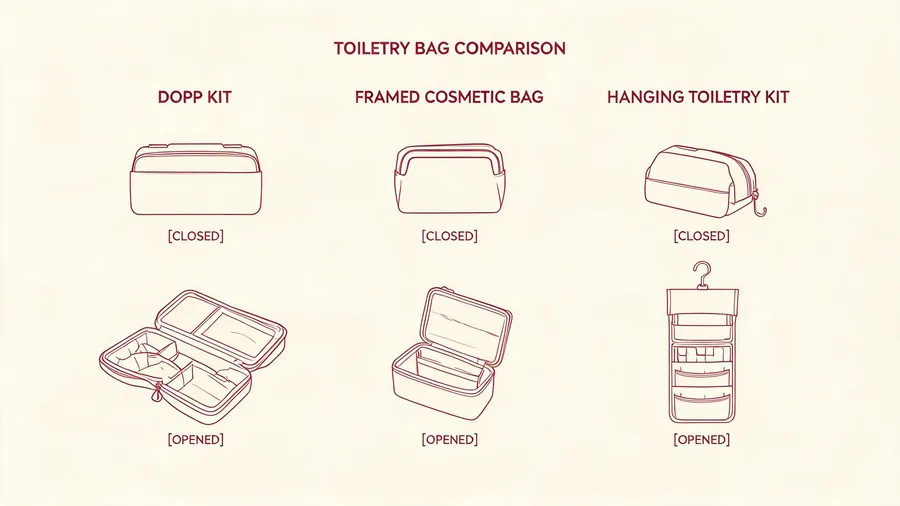
A framed bag has a stiffened opening, usually a wire or plastic frame sewn into the top edge. The bag stays open on its own. Access is fast. The frame adds production cost and a failure point if the frame pokes through the seam. It also makes the bag bulkier to pack. Brands selling a premium shaving kit often choose a framed opening because the open mouth reads as quality in product photos.
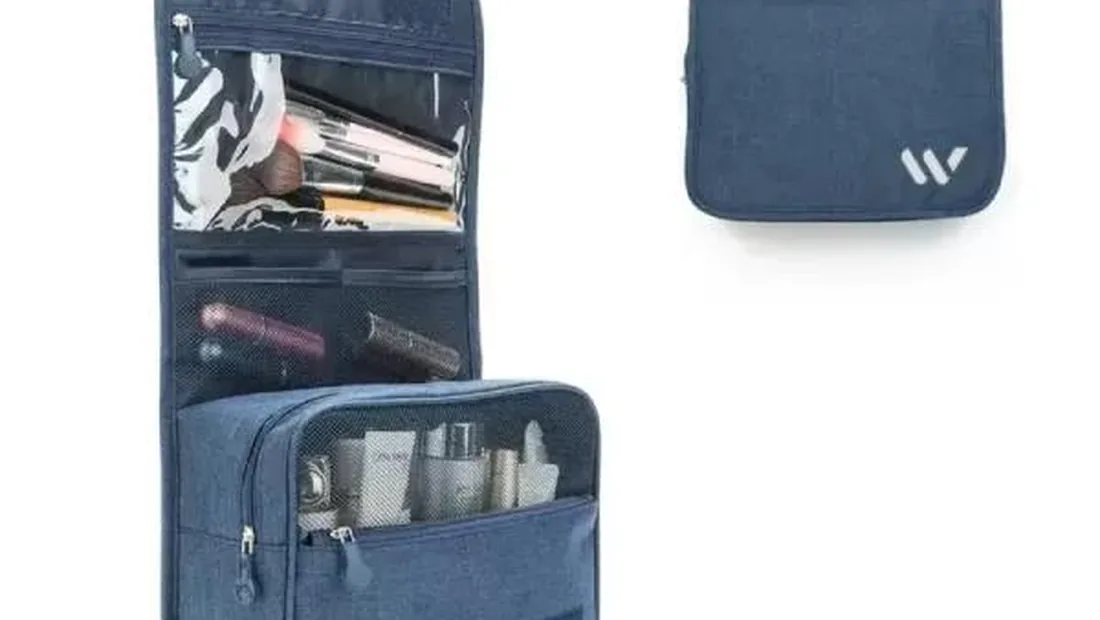
A hanging kit adds a hook so the bag hangs from a towel bar or shower rod. The hook requires reinforcement because the complete load is concentrated at one attachment point. A reinforcement patch or bar-tacked webbing at the hook base is standard. Without it, the hook tears out. A hanging kit also needs a layout that works vertically. Pockets should open sideways or the contents fall out. Many hanging kits combine a clear film pocket for visibility with mesh pockets for drainage.
Structure affects packing, visibility, and production cost. A soft pouch is the cheapest to sew. A framed bag needs an extra component and an extra operation. A hanging kit needs the hook, reinforcement, and often more internal organization. Each choice changes the bill of materials.
Waterproof linings and why a wipeable interior matters
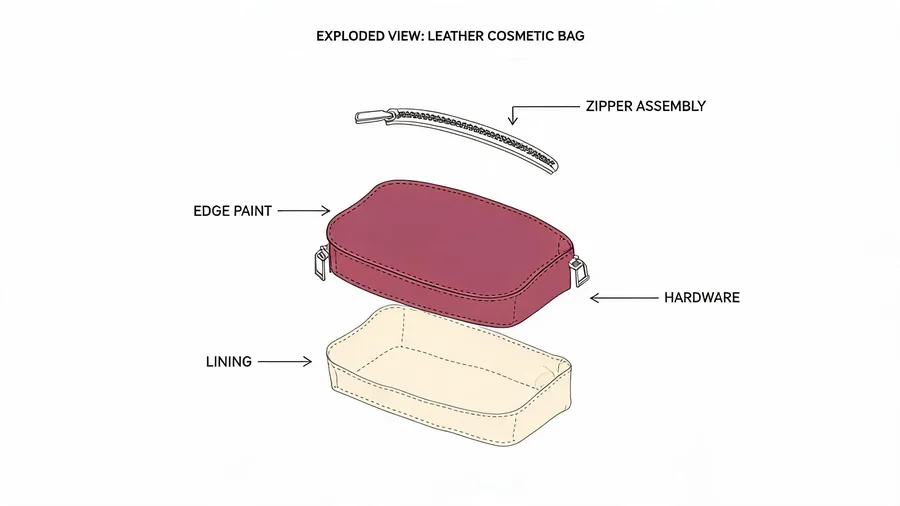
A men's toiletry bag holds wet things. Shampoo bottles, razors, toothbrush heads. The lining decides whether a spill stays inside or soaks through. Cleanability depends on surface smoothness, seam construction, corner geometry, and material compatibility with expected residues. A wipe-clean liner reduces absorption. Welded or sealed seams provide better leak containment than ordinary stitched seams.
Leak-resistant construction delays liquid escape but is not guaranteed to remain liquid-tight under pressure or prolonged exposure. Leakproof construction is designed and tested to prevent liquid passage under stated test conditions. The exact test values depend on the agreed specification. Don't let a factory claim "waterproof" without a test method attached.
A stitched bag may still use a removable waterproof insert when full seam sealing is unnecessary. The insert isolates spills and simplifies cleaning. Imagine a brand selling a canvas dopp kit with a PU-coated interior. The stitched seams might seep at the corners. A removable PEVA insert solves that without changing the outer construction. It adds a component, but it protects the return rate.
For a leather bag, the lining is usually a coated polyester or a film-based material. PU coating improves water resistance and hand feel. Thermoplastic polyurethane film is used for waterproof laminates and welded constructions. A smooth coated inner surface cleans with limited moisture. That's what a buyer should specify, not just "waterproof lining." Our lining guide covers the material options in more detail.
Hardware, edge paint, and turned edges: where quality shows
Hardware is where a cheap bag announces itself. A metal zipper with a smooth pull feels different from a plastic coil zipper. Metal zippers hold up better on a curved opening. Plastic zippers are lighter and cheaper. For a men's leather kit, most brands choose metal. The zipper pull matters too. A small, flimsy puller is hard to grip with wet hands. A larger puller or a leather pull tab costs almost nothing and changes the daily experience.
Metal feet on the base protect the leather from countertop moisture. They're common on framed bags and structured kits. They add four components and four rivets. The cost is small. The perceived quality jump is real.
Edge paint versus turned edges is another spec point. Edge paint is a coating applied to the cut edge of the leather. It seals the fibers and gives a clean, colored line. It can crack or wear with heavy use. Turned edges fold the leather over and stitch it, hiding the raw edge entirely. Turned edges are more durable but add labor and require thinner, more flexible leather. On a soft pouch, turned edges work well. On a thick full grain bag, edge paint is often the only practical option. A buyer who specifies both without checking feasibility will get a confused sample.
Reinforcement at stress points matters. The zipper ends, the handle attachments, the hook base. A reinforcement patch at each point adds a few seconds of sewing time and prevents field failures. This is where quality shows after six months of daily use.
Sampling and spec points for a men's leather cosmetic bag
Sampling starts with a complete spec document. Not a sketch. A document that names the leather grade, temper, thickness, color, lining material, lining color, zipper type, puller style, edge finish, hook type if any, and logo process. A buyer who sends only a photo will get a sample that looks right and feels wrong.
Sample lead time for a cosmetic bag runs one to ten days depending on materials and logo process. Revision rounds take two to three days each. Paid samples are standard. Free samples are not. Budget for two rounds. The first sample confirms structure and materials. The second confirms the logo and final color.
MOQ for cosmetic bags starts at 500 pieces. That's our standard structure. Special materials or complex constructions can raise it. For a men's leather bag, the leather itself is the main variable. A factory needs enough hide to cut efficiently. Small runs waste material. Ask your supplier to confirm the MOQ for the specific leather and lining combination before you commit to a sample.
Production lead time for a fully custom cosmetic bag runs seven to fifteen days after sample approval. Larger orders or complex structures take longer. Quality checkpoints should include leather color consistency, zipper function, edge finish adhesion, and logo placement. We provide 24-hour response on after-sales issues and offer replacements, credits, or technical support. That's the minimum a brand should expect from any factory.
If you're still comparing structures, our custom pouch page shows soft construction options. For material comparisons beyond leather, the materials guide covers coated fabrics and linings. And if you're ready to spec a sample, contact us with your document. Email [email protected] or WhatsApp +1 626 734 5510. We reply within 24 hours.
Frequently Asked Questions
What is a man's cosmetic bag called?
A dopp kit, toiletry bag, shaving kit, or wash bag. Dopp kit is the most common term in the US. It originally referred to a specific brand but now means any small men's travel case for grooming items.
Are leather toiletry bags worth it?
For a brand, yes, if the target customer values aging and patina. Full grain and top grain leather last longer than PU and look better with use. For a lower price band, PU or vegan leather is more consistent and easier to decorate. The choice depends on brand position, not on leather being universally better.
What is the best leather men's toiletry bag?
There is no single best bag. A full grain framed bag suits a premium brand. A top grain soft pouch suits a mid-price brand. A PU hanging kit suits a value brand. The best bag is the one that matches the price band, logo process, and structure the brand can sell.
What should a brand specify when developing a men's leather toiletry bag?
Leather grade, temper, thickness, color, lining material, lining color, zipper type, puller style, edge finish, hook type if any, and logo process. Put it all in one document. A photo alone is not a spec. Confirm MOQ and sample lead time before ordering samples.