Toiletry Cube Guide: Formats, Specs, and Sourcing Logic

A toiletry cube is a structured travel organizer with a wide top opening and internal compartments. It holds bottles, brushes, and tools upright. It packs flat when empty. It opens like a small trunk. Buyers building a travel organizer line often start here because the format is easy to explain and easy to upsize.
But a cube is not the only format that earns space in a carry-on. The flat pouch, the hanging fold-out, the roll-up, and the clear TSA-style pouch all solve different packing problems. They differ in capacity, access speed, cleanability, and cost to build. This guide compares them as factory-side specs, not as retail trends.
Before you choose a format, decide what the user is actually managing. Wet items. Dry items. Small tools. A full-size bottle. A toothbrush that touches nothing else. Each answer pushes the spec toward a different construction. The table below is the short version. The sections after it explain where the cost and quality actually live.
Format Comparison Table
Use this as a first-pass filter. The cost column assumes comparable materials and a 500-piece order. Real pricing depends on fabric, hardware, and labor steps, not on the format name.
| Format | Capacity logic | Packability | Access | Cleanability | Relative build cost |
|---|---|---|---|---|---|
| Toiletry cube | High for footprint; upright storage | Folds near flat when empty | Wide top opening, one-hand use | Good with wipe-clean liner | Mid to high |
| Flat pouch | Low to mid; limited depth | Excellent, rolls or folds | Fast, shallow visibility | Good, fewer corners | Low |
| Hanging fold-out | High; spreads load across panels | Moderate; folds flat but thick | Excellent when hung | Panel-by-panel, more surface | High |
| Roll-up | Mid; depends on loop count | Good, rolls to compact tube | Moderate, needs unrolling | Good, open flat for wiping | Low to mid |
| Clear TSA-style pouch | Low to mid; visibility over volume | Excellent, very flat | Fast, contents visible | Very good, smooth film | Low |
Toiletry Cube Construction
The cube works because of its gusset. The side panel gives the bag depth. Without it, you have a flat pouch. With it, you have a container. The gusset is where most of the sewing time goes.
A basic cube has four vertical walls, a bottom panel, and a top lid. The lid zipper usually runs around three sides. That gives a wide opening. The user sees everything at once. No digging.
Inside, the simplest cube is empty. That is cheap but weak. Most buyers add at least one divider or a few elastic loops. The loops hold cylindrical items upright. Brushes stop touching each other. A bottle stays where it was packed. Elastic loops also add a labor step. Each loop is cut, folded, and bartacked. More loops means more minutes per unit.
Mesh pockets are common on the lid. They provide visibility and drainage. But mesh offers limited liquid containment. If a shampoo bottle leaks inside a mesh pocket, the liquid reaches the rest of the bag. Clear film pockets are different. They improve content identification and wipe-clean performance. They also cost more than mesh and can yellow over time if the film is low grade.
A removable pouch inside the cube is a practical upgrade. It isolates wet or spill-prone items. The user can pull the pouch out and clean it separately. For a stitched cube that is not fully seam-sealed, a removable waterproof insert does the same job without forcing the entire bag into leakproof construction. The industry reference describes this exactly: a stitched bag may still use a removable waterproof insert when full seam sealing is unnecessary.
Internal Configuration and Cleanability
Cleanability depends on surface smoothness, seam construction, corner geometry, and material compatibility with expected residues. That is the technical truth. A wipe-clean liner reduces absorption. Welded or sealed seams provide better leak containment than ordinary stitched seams. A stitched bag with a coated liner still leaks through the needle holes unless the seams are taped or welded.
For a cube, the corners matter. Sharp internal corners trap residue. A rounded or gusseted corner is easier to wipe. If the spec calls for a washable compartment, a drainage eyelet helps. It is a reinforced opening that lets water escape. But it only makes sense on a wet-use bag. On a dry toiletry cube, an eyelet is a leak path.
Leak-resistant and leakproof are not the same thing. Leak-resistant construction delays liquid escape but is not guaranteed under pressure. Leakproof construction is designed and tested to prevent liquid passage under stated test conditions. If your brand promises leakproof, the spec must name the test conditions. Otherwise the claim is decoration.
For a cube that must hold a full-size bottle upright, add a bottle retention feature. A simple elastic band across one corner works. A dedicated bottle sleeve with a bottom gusset works better. The sleeve keeps the bottle from tipping and keeps the cap above the rest of the contents. This matters more in a cube than in a flat pouch because the cube has real depth. Items shift in three directions.
Wet and dry separation is usually a divider plus a coated panel. The wet side gets a wipe-clean liner. The dry side gets mesh or fabric. The divider itself should be coated or film-backed. A fabric-only divider lets moisture wick through. That defeats the separation.
The Hanging Hook and Its Anchor
A hanging hook is simple to spec and easy to get wrong. The hook carries the complete load of the bag. Every bottle, every tool, every gram hangs from one attachment point. That point needs reinforcement.
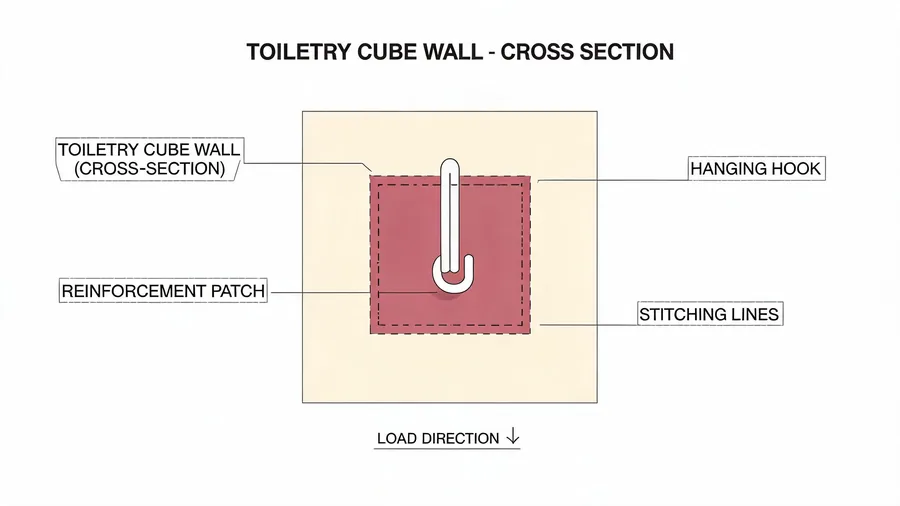
The industry reference states this plainly: a hanging hook requires reinforcement because the complete load is concentrated at one attachment point. In practice, that means a bartack through the webbing, the shell fabric, and an internal reinforcement patch. Some factories sew the hook tab into the top seam allowance. That is stronger than surface stitching.
The hook itself matters too. A metal hook is stronger but can scratch bathroom fixtures. A plastic or coated hook is gentler but more likely to fail at the gate. The spec should name the hook material, the gate opening, and the breaking strength. Do not accept a hook with no stated load rating. The bag will be hung over a door or a towel bar. The load is dynamic. It sways.
For a hanging fold-out format, the hook is the primary feature. The entire organizer hangs open. Each panel becomes a shelf. The hook anchor carries not just the packed weight but the leverage of the open panels. If the anchor fails, the bag drops. The user loses trust in the brand. Reinforce it properly or do not offer the format.
Carry-On Size Logic
Carry-on rules vary by airline. A bag that fits one carrier may not fit another. The practical approach is to design for a common footprint and state the measurements clearly. Buyers do not want to guess.
A cube that fits a carry-on suitcase is usually sized to sit flat in the main compartment or in the lid pocket. The cube should not force the suitcase to bulge. Depth is the first dimension to control. A cube that is too deep becomes awkward in a shallow carry-on. A cube that is too shallow loses its upright storage advantage.
For a clear TSA-style pouch, the logic is different. The pouch must fit the screening tray and the agent's line of sight. Visibility matters more than volume. The pouch should open wide and close with a smooth zipper. No hidden corners. No opaque lining. The user wants the agent to see everything without opening the bag. Our clear PVC toiletry pouch is built around that logic.
For a hanging fold-out, the packed size is less important than the unfolded size. The organizer needs enough panel area to hold a full kit. But it must still roll or fold into a shape that fits a carry-on. The hook and the folded bulk compete for space. That is why the format costs more to build well.
The roll-up format is the most flexible on size. It rolls to a compact tube. The user can compress it against the side of a suitcase. But access is slower. The user must unroll the entire organizer to reach one item. For a quick overnight trip, that is fine. For a daily routine, it gets old.
Specification Points That Decide Quality
When you write the spec, do not stop at the format name. The format name tells the factory what to build. The spec tells the factory how to build it. These are the points that separate a good organizer from a return.
First, the dimension diagram. Every panel needs a measurement point, a nominal value, and a tolerance. The industry reference lists height, width, depth, capacity, opening length, and pocket opening as standard measurements. Without a diagram, the factory guesses. Guessing produces a sample that does not match your line sheet.
Second, the bill of materials. Fabric weight, coating, finish, and approved color. Hardware sizes and finishes. Zipper type and slider. Elastic width and stretch. Thread color. Every item on the list. If it is not on the list, the factory will substitute.
Third, the seam types. A cube has vertical seams, a bottom seam, and a lid seam. Each one carries different stress. The bottom seam carries the packed weight. The lid seam carries repeated opening and closing. Stitch density and reinforcement details need to be stated. Do not write "strong seams." Write the seam type and the stitch count.
Fourth, the artwork. Logo placement coordinates, process, colors, and durability requirements. On a cube, the logo usually sits on the front panel or the lid. On a clear pouch, the logo may sit on a small fabric trim. On a hanging organizer, the logo may sit on the hook tab. Each placement has different durability risks.
Fifth, the packing method. A cube needs shape-control inserts or it arrives crushed. A hanging organizer needs the hook protected. A clear pouch needs a polybag that prevents scratching. Carton quantity and carton marks matter for warehouse receiving. Shipping tests matter for e-commerce. The spec should name them.
If you are building a full travel organizer line, the cube is the anchor format. It is the most versatile. It scales from a small quilted makeup bag up to a full hanging kit. The flat pouch and the clear pouch cover the budget end. The hanging fold-out covers the premium end. The roll-up covers the niche. One line, four formats, one spec discipline.
For a deeper look at the hanging format, see our hanging toiletry bag product page. For the clear pouch in a quart-size footprint, see the TSA quart-size toiletry bag. Both pages show the construction details described here.
Start with the cube. Spec it carefully. Then expand the line. The formats are different. The spec discipline is the same.
Frequently Asked Questions
What is the difference between a toiletry cube and a flat pouch?
A cube has a gusset that gives it real depth, so it holds bottles and brushes upright and opens like a small trunk. A flat pouch has little or no gusset, packs flatter, and costs less to build, but it offers less upright storage and less internal organization.
How do I spec a hanging hook that will not fail?
Name the hook material, gate opening, and breaking strength, and require the hook tab to be bartacked through the shell fabric and an internal reinforcement patch. The hook carries the complete packed load, so the anchor is the critical point, not the hook itself.
Can a toiletry cube be leakproof?
Yes, but only if the spec states the test conditions. Leakproof construction is designed and tested to prevent liquid passage under stated conditions. A stitched bag with a coated liner is leak-resistant at best unless the seams are taped or welded, or a removable waterproof insert is used.
What size should a toiletry cube be for carry-on travel?
Size it to sit flat in the main compartment or lid pocket of a common carry-on without forcing a bulge. Depth is the first dimension to control. For a clear TSA-style pouch, prioritize visibility and a shape that fits the screening tray over raw volume.