Makeup Brush Bag Roll Guide: Brush Storage Formats
A makeup brush bag roll is a fabric panel with elastic loops that hold brushes in place before the panel rolls or folds shut. It is the format most beauty brands ask us about first. You see it in pro kits and travel sets because it protects bristles without adding much weight. But a roll is not always the right answer. Some lines need a zippered case. Some need a standing cup. The choice depends on how your customer actually uses the brushes.
This guide covers the four main brush storage formats, the construction details that matter in transit, and the buyer situations each format suits. I have answered these questions for brands selling into salons, subscription boxes, and travel retail. The details below are the ones that determine whether brushes arrive intact or arrive looking crushed.
Four Brush Storage Formats
There is no single best format. There is a best format for a given retail price, brush count, and end user. Here are the four we build most often.
Roll-Up Panel
The roll-up panel is a flat fabric panel with elastic loops stitched in rows. Brushes slide into the loops, the top flap folds down over the bristles, and the whole panel rolls from one end. A tie or strap holds the roll closed. This format protects bristles well because each brush sits in its own loop and the flap prevents contact between rows. It rolls compactly and fits into a tote or kit.
The weakness is capacity. A roll holds maybe eight to twelve brushes before it gets bulky. It also works best for brushes with similar handle lengths. Very long handles stick out past the flap. Very short handles disappear into the loops and are hard to pull out.
Zippered Brush Case
A zippered brush case is a structured pouch with elastic loops inside, usually on one or both sides. The case opens flat like a book. Brushes sit in loops on each panel. A divider or flap separates the two sides when closed. This format holds more brushes than a roll and offers better crush protection because the case walls are stiffer.
Buyers choose a zippered case when the brush set is larger or when the customer wants a cleaner presentation. It costs more to make than a roll. The zipper, the structure, and the extra fabric all add up. But for a premium line, the case reads as a product, not an accessory.
Brush Guards Inside a Larger Bag
This is the lightest option. A larger makeup bag or toiletry bag gets a row of elastic loops on one interior wall. Brushes slide in and ride alongside palettes, bottles, and tools. The loops keep brushes from rattling around loose. A flap or mesh pocket covers the bristles.
This format suits lines where brushes are an add-on, not the hero. It adds almost no cost to the main bag. The tradeoff is protection. Brushes share space with other items, so bristles can still get pressed by a heavy bottle or compact. A rigid board behind the loops helps.
Standing Brush Cup
A standing brush cup is a cylindrical or tapered fabric container with elastic loops or slots around the rim. It stands upright on a vanity. Brushes sit handle-down or bristle-up. This is the format for daily use at home, not travel. It offers fast access and keeps brushes visible.
The construction challenge is the base. The cup needs a rigid bottom and enough structure in the walls to stay open. Without a board or heavy interfacing, it collapses into a puddle of fabric. We build these less often than rolls and cases, but they have a steady niche in gift sets and vanity organization lines.
Format Comparison Table
The table below matches each format to the buyer situation it suits. It is a starting point, not a final answer. Your brush count, retail price, and end user will push you one way or another.
| Format | Best for | Protection level | Cost to produce | Typical buyer situation |
|---|---|---|---|---|
| Roll-up panel | Pro kits, travel sets, 8-12 brushes | Good bristle protection, moderate crush resistance | Low to moderate | A brand selling a compact travel brush set where weight matters |
| Zippered brush case | Larger sets, premium lines, 12-20 brushes | High, with structured walls | Moderate to high | A brand positioning a complete brush collection as a gift or pro purchase |
| Brush guards in larger bag | Brush add-ons, value sets | Basic, keeps brushes organized not isolated | Low | A brand adding a brush loop row to an existing makeup pouch line |
| Standing brush cup | Vanity use, gift sets | Bristle protection from the rim, no crush protection | Moderate | A brand selling a daily-use vanity organizer or holiday gift set |
Elastic Loop Spacing and Depth
This is where most brush storage designs fail. A loop that is too tight breaks bristles. A loop that is too loose lets brushes fall out in transit. The right loop depends on the brush, not on a generic spec.
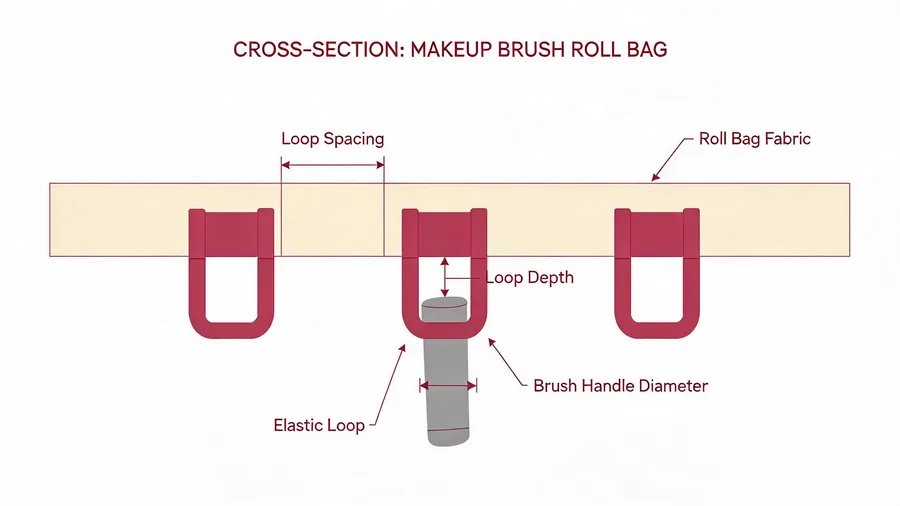
Measure the widest handle in your set. The loop should stretch enough to hold that handle snugly without deforming the bristles above it. For a brush with a slim lacquer handle, a narrow loop works. For a chunky powder brush with a thick handle, you need a wider loop or a two-loop system. The loop spacing, the distance between adjacent loops, should leave enough room for the bristle head to sit without touching the next brush. Crowded loops cause bristle crossover. That leads to bent hairs and a cheap look when the customer opens the roll.
Loop depth matters too. A shallow loop holds only the tip of the handle. A deep loop grabs more of the handle but makes the brush harder to remove. The right depth is usually about a third to half of the handle length, but that changes with handle shape. A brush with a tapered handle needs a deeper loop. A brush with a straight cylindrical handle can sit in a shallower loop.
The elastic itself matters. Cheap elastic loses tension after a few dozen uses. The loops go slack and brushes fall out. We spec a woven or braided elastic with good recovery. The exact width and stretch percentage get set in the approved specification. The key is to test the loop with your actual brush set before production. A sample with one loop size costs less than a container of returns.
Rigid Boards and Bristle Protection
Bristles crush when pressure lands on the tip. In a soft roll or case, that pressure comes from the outside: a heavy item in a suitcase, a stack of boxes in a shipping carton, a customer overpacking a tote. A rigid board behind the brush area spreads that load and stops the bristles from bending.
The board can be a thin plastic sheet, a fiberboard panel, or a dense foam layer. Plastic board is light and wipes clean. Fiberboard is stiffer but less tolerant of moisture. The choice depends on the bag's lining and the expected use. We usually place the board behind the elastic loop panel, so the brushes sit against a firm surface. The board also gives the roll or case its shape, which helps in retail display.
The board does not need to be thick. It needs to be stiff enough to resist bending under the expected load. A board that flexes too much offers no real protection. A board that is too thick makes the roll hard to close. The exact thickness gets set in the specification after we know the brush sizes and the intended use.
Flaps, Guards, and Contamination Control
Brushes carry product residue. In a shared kit or a travel bag, that residue transfers to other brushes, to the lining, and to anything else in the bag. A flap or guard between the bristles and the rest of the bag reduces that transfer.
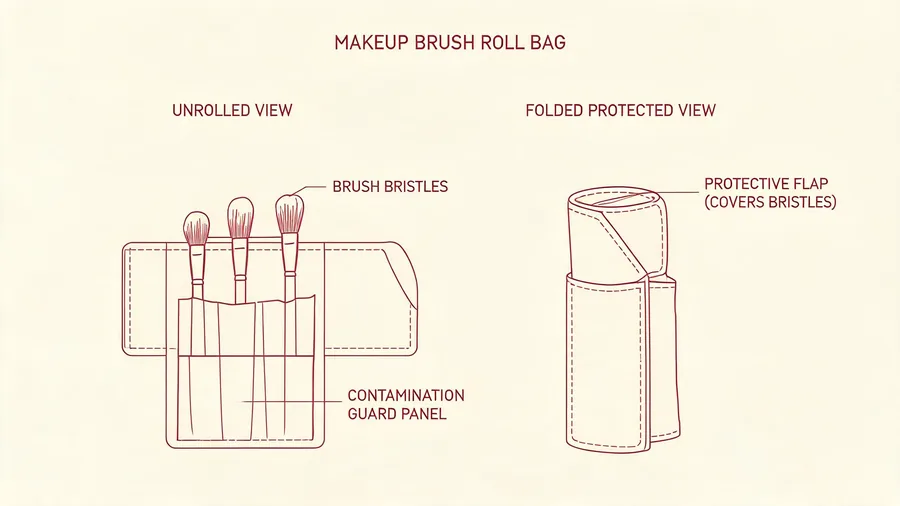
The simplest guard is a fabric flap that folds over the bristles before the roll or case closes. The flap can be a separate panel or an extension of the loop panel. It keeps bristles from touching the opposite side of the case. For a roll, the flap also stops bristles from catching on the tie or strap.
A brush guard is a small sleeve or cap that slides over the bristles of a single brush. It is common in pro kits where brushes are used wet. The guard protects the bristle shape and keeps product from smearing onto the lining. Guards add cost and bulk, so they suit premium lines more than value sets.
For a larger bag with brush loops inside, a mesh or clear film pocket over the bristles works well. The mesh allows airflow, which helps if brushes are packed slightly damp. A clear film pocket allows the customer to see the brushes without opening the pocket. Both options reduce contamination from loose powders and liquids in the main compartment.
Lining Materials That Clean Easily
The lining is the surface that touches the bristles. It should be smooth, non-absorbent, and easy to wipe. A rough or absorbent lining grabs powder, oil, and pigment. It stains and it transfers color back onto the brushes.
We use a few lining materials for brush storage. A polyurethane-coated fabric is common. It wipes clean with a damp cloth and resists most cosmetic residues. A clear polymer film works well for pockets and flaps because the customer can see the brushes. A smooth nylon lining is lighter and cheaper, but it absorbs more than a coated fabric. For a brush roll or case, we usually recommend a coated or film lining over an uncoated fabric.
Seam construction matters as much as the material. A stitched seam with raw edges traps powder and is hard to clean. A bound or welded seam is smoother and resists buildup. For a brush case, welded seams also improve leak resistance if a liquid product spills inside. The exact lining and seam spec depends on the brush types and the price point.
If you are choosing materials for a full makeup bag line, the makeup bag materials guide covers shell fabrics, coatings, and linings in more detail.
Construction Details for Transit
Brushes stay put in transit when three things are right: the loops hold, the flap stays closed, and the outer shell resists crushing. Miss any one and the brushes arrive damaged.
The loops are the first failure point. They need to be stitched into a seam or bar-tacked at both ends. A loop stitched only at the top pulls loose. The elastic should be cut long enough to allow the brush in and out, but short enough to hold tension. We test this with the actual brush set and a shake test.
The closure matters next. A roll that comes unrolled in a suitcase spills brushes into the bag. A tie is the simplest closure, but it loosens. A strap with a hook-and-loop fastener holds better. For a case, the zipper should have a locking slider or at least a firm pull. A flimsy zipper opens under pressure.
The outer shell is the last line of defense. A brush roll made from thin fabric offers no crush protection. A padded shell or a rigid board behind the loops changes that. For a case, the walls themselves should have some structure. This is where the bulk makeup bag construction choices carry over. The same shell materials and padding options apply.
One more detail: the roll or case should close without forcing the bristles. If the customer has to press down hard to close it, the brushes are already being crushed. The internal height should match the longest brush in the set. Leave a little clearance. A tight fit looks neat in photos but destroys bristle shape over time.
Choosing the Right Format for Your Line
Start with the brush set. How many brushes, what handle lengths, what bristle types. Then look at the retail price. A roll costs less to make than a structured case. A brush guard row inside an existing bag costs almost nothing. Then look at the end user. A pro makeup artist needs protection and organization. A travel customer needs compactness. A vanity customer needs access.
If your line is travel-focused, the roll-up panel is usually the right call. It is light, it packs flat, and it protects bristles. If your line is a complete brush collection, the zippered case presents better and holds more. If brushes are a secondary item, put loops inside the main bag and add a flap. If the customer uses brushes daily at a vanity, the standing cup is the format that gets used.
For brands ordering custom brush storage, the MOQ depends on the construction. A simple roll with standard elastic loops has different minimums than a structured case with boards and welded seams. We quote these case by case. Contact us with your brush specs and we will confirm the MOQ for your design.
FAQ
Here are the questions we hear most from buyers sourcing brush storage.
What is the MOQ for custom makeup brush rolls?
Low MOQs, contact us. The minimum depends on the construction, fabric, and whether you need custom elastic, boards, or closures. A simple roll is different from a structured case. Send your brush specs and we will confirm.
Can you match my brand's Pantone colors on the fabric and elastic?
Yes. We match fabric and elastic to your Pantone reference with a color difference of ΔE≤2.0. The elastic color is matched separately because elastic dyes differently from woven fabric. A lab dip is approved before production.
How do I know the loops will fit my brushes?
Send us the handle diameter and length for each brush in your set. We make a pre-production sample with loop sizes matched to those measurements. You test the sample with your actual brushes before we run production. The sample is paid, but it is cheaper than a container of returns.
What lining is best for brushes used with liquid or cream products?
A polyurethane-coated lining or a clear polymer film. Both wipe clean and resist absorption. Avoid uncoated cotton or rough fabrics. For brushes packed damp, add a mesh pocket or allow airflow in the design.
Frequently Asked Questions
What is the MOQ for custom makeup brush rolls?
Low MOQs, contact us. The minimum depends on the construction, fabric, and whether you need custom elastic, boards, or closures. A simple roll is different from a structured case. Send your brush specs and we will confirm.
Can you match my brand's Pantone colors on the fabric and elastic?
Yes. We match fabric and elastic to your Pantone reference with a color difference of ΔE≤2.0. The elastic color is matched separately because elastic dyes differently from woven fabric. A lab dip is approved before production.
How do I know the loops will fit my brushes?
Send us the handle diameter and length for each brush in your set. We make a pre-production sample with loop sizes matched to those measurements. You test the sample with your actual brushes before we run production. The sample is paid, but it is cheaper than a container of returns.
What lining is best for brushes used with liquid or cream products?
A polyurethane-coated lining or a clear polymer film. Both wipe clean and resist absorption. Avoid uncoated cotton or rough fabrics. For brushes packed damp, add a mesh pocket or allow airflow in the design.