Clear Cosmetic Bags in Bulk: Materials and Spec
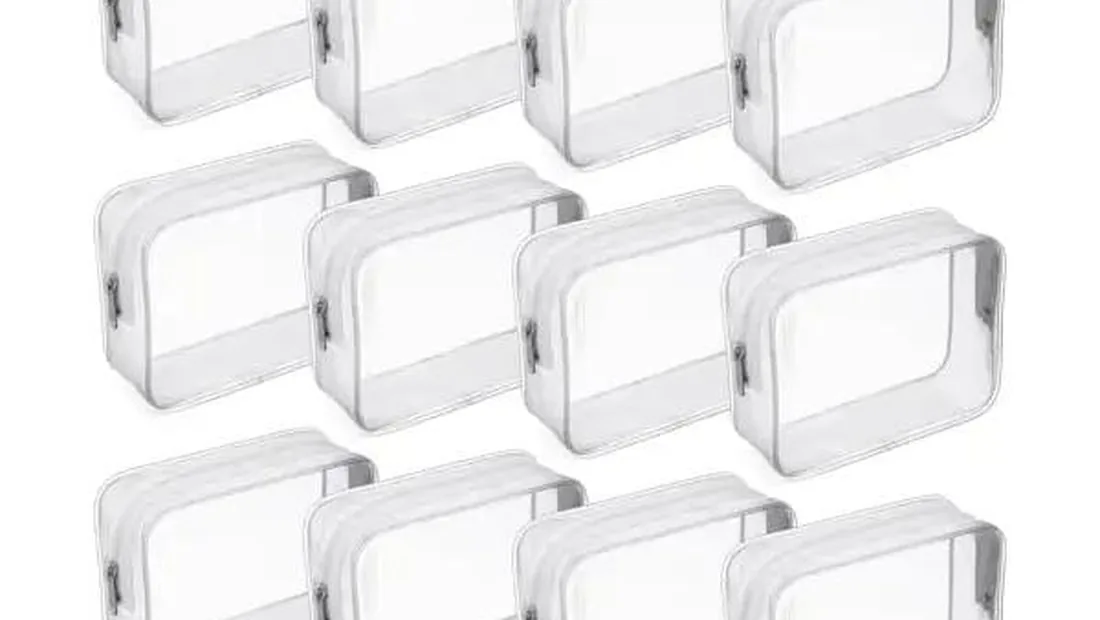
Clear cosmetic bags in bulk look simple. They're not. A transparent bag exposes every material choice, every seam, and every cheap shortcut. Buyers who treat these as a commodity usually learn that lesson on the first reorder.
You're buying a window into the bag's construction. That changes the spec. The film, the binding, the zipper tape, the stitch line. All visible. All judged at arm's length by the end user.
This guide covers the transparent material options, what thickness does to feel and failure, the ways clear materials break down, the construction details that slow that down, cleanability, and how branding works on a panel you can see through.
Transparent material options and how they behave
Four materials dominate clear cosmetic bag production. PVC, TPU, PEVA, and clear film with fabric binding. Each behaves differently under cold, heat, folding, and time.
PVC is the workhorse. It's stiff enough to hold a shape, takes high-frequency welding well, and prints acceptably. It's also the material most likely to yellow after long storage in warm conditions. The plasticizer migrates over time. Nothing stops that completely.
TPU is the premium option. It stays flexible at low temperatures, resists yellowing better than PVC, and welds cleanly. You'll pay more. TPU also tends to have a softer hand feel, which matters for a pouch that sits in a purse or on a hotel bathroom counter.
PEVA is the chlorine-free alternative. It's lighter than PVC, softer, and often chosen when a retailer wants to avoid vinyl language on the packaging. Durability is lower. PEVA scratches more easily and doesn't take repeated flexing as well as PVC or TPU.
Clear film with fabric binding is a different animal. The transparent panel is usually PVC or TPU film, but the edges are bound in polyester or cotton webbing and stitched rather than welded. This gives you a softer, more finished look. It also introduces stitch holes, so the bag is not leak-resistant unless a separate sealed liner is added.
Thickness and what it changes
Film thickness is measured in gauge or millimeters, and it's the first number buyers ask about. Thicker film feels more substantial. It resists punctures better. It also folds worse.
Say you're comparing two clear pouches side by side. One uses a thin, flexible film. It drapes, it's light, it packs flat. The other uses a stiff, heavy-gauge film. It stands up on a shelf, feels expensive, but creases hard when folded into a suitcase. Neither is better. They're for different products.
Thickness interacts with the welding process. Very thin film welds quickly but leaves less margin for error. Too much heat and you get distortion at the seam. Very thick film needs longer dwell time and more controlled pressure. A factory that runs cosmetic bags daily knows where those limits sit. The spec sheet should name the film thickness and the tolerance.
Feel matters more than most buyers expect. A hotel amenity pouch gets handled once. A daily makeup bag gets squeezed, dropped, and stuffed. The right thickness is the one that survives the worst moment in normal use, not the average moment.
Failure modes specific to clear materials
Clear bags fail in ways opaque bags don't. The material itself is the weak point, not just the stitching.
Fold cracking is the classic. Repeated bending at the same line, usually where the bag folds for storage or shipping, creates stress whitening first. Then a small crack. Then a tear. Cold temperatures accelerate this. PVC is most prone, especially in unheated warehouses or winter delivery vans. TPU handles cold flexing far better.
Seam stress is the second failure. On a welded clear bag, the seam is a fused line of film. That line is often stiffer than the surrounding material. When the bag is overstuffed, the film flexes right at the seam edge and fatigues. The fix is a wider weld, a rounded corner instead of a sharp one, or a reinforcing strip at the stress point.
Yellowing is slow and ugly. It's oxidation and plasticizer migration, accelerated by UV exposure and heat. A clear bag stored in a hot container for two months can come out looking like it aged two years. PEVA yellows less than PVC but still changes. TPU is the most stable of the three.
Zipper tape separation is the failure nobody sees coming. The zipper tape is usually a different material from the clear film. Different expansion rates, different flexibility, different surface energy. If the tape isn't welded or stitched with enough contact area, it peels away from the film under repeated zipper pulls. This is a construction problem, not a material problem. A strong tape bond is non-negotiable.
Construction details that prevent failure
The difference between a clear bag that lasts and one that doesn't is rarely visible in a product photo. It's in the corners, the seam width, and the reinforcement.
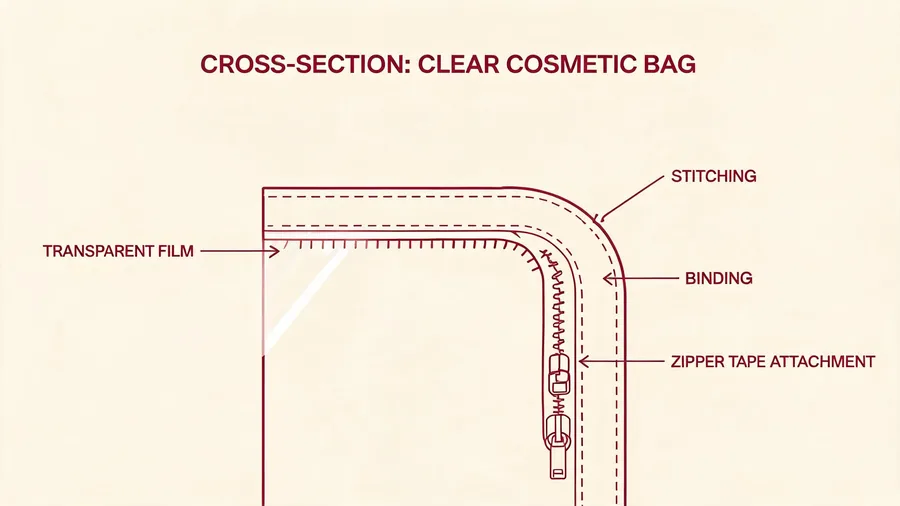
Rounded corners beat sharp corners. A sharp corner concentrates stress at one point. A radius spreads it. This matters most on welded bags, where a sharp inside corner is a tear waiting to happen.
Reinforcement patches at the zipper ends and any hanging loop take load off the film. A small patch of fabric or a second layer of film at the attachment point makes the bag dramatically more durable. The cost is tiny. The benefit is real.
For stitched clear bags with fabric binding, the binding itself is the reinforcement. It wraps the raw film edge and prevents tear propagation. But the stitch holes remain, so the bag is not sealed. If you need leak resistance, you're looking at a welded construction or a separate inner liner.
Imagine a buyer ordering 800 clear pouches for a hotel chain. The spec calls for a welded TPU body with a fabric-bound top edge and a reinforced hanging loop. That bag survives daily housekeeping use. The same bag with sharp corners and no reinforcement gets returned within a season.
Cleanability, leak resistance, and leakproof claims
These three terms are not interchangeable. They describe different performance levels, and each needs its own passed test.
Wipe-clean means the inner surface can be cleaned with limited moisture. A smooth coated or film-based surface qualifies. It doesn't mean the bag holds liquid. It means you can wipe spilled powder or a smudge off the inside without soaking it.
Leak-resistant means the construction delays liquid escape. It's not guaranteed to stay liquid-tight under pressure or prolonged exposure. A stitched bag with a coated lining might be leak-resistant. So might a welded bag with a small pinhole at the seam.
Leakproof means the bag is designed and tested to prevent liquid passage under stated test conditions. Those conditions must be written down. What liquid, how much, how long, what orientation. A bag that passes a 30-minute test with water at room temperature is not automatically leakproof for oil or for a full day in a hot car.
Don't write "leakproof" on a spec sheet without a test behind it. The claim creates liability. Write the test method and the pass criteria instead.
Printing and branding on transparent panels
Branding on clear film is constrained. You can't print a full-coverage opaque design on a transparent panel and keep it transparent. The ink itself blocks the view.
Spot printing works. A logo, a pattern, a border. Screen printing on PVC and TPU is common. The ink adhesion depends on surface treatment. Untreated film rejects ink. Corona or plasma treatment improves it, but the treatment fades over time. Print soon after treatment.
Hot stamping is another option. A metallic or solid-color foil is pressed onto the film with heat. It looks sharp on clear material and holds up well. It's best for small areas like a logo or a monogram.
Woven labels and hang tags avoid the adhesion problem entirely. A woven label stitched into the binding or a hang tag attached to the zipper pull carries the brand without touching the film. This is often the cleanest solution for clear bags.
If the bag uses a fabric binding, you can print on the binding instead of the film. That gives you full-color branding on a stable surface while the transparent panel stays clear. It's a smart way around the limitations.
Material comparison table
| Material | Clarity | Flexibility | Yellowing resistance | Typical construction | Best for |
|---|---|---|---|---|---|
| PVC | High | Stiff to medium | Low to medium | Welded | Value lines, promotional giveaways |
| TPU | High | Soft, stays flexible in cold | High | Welded | Premium travel, hotel amenities |
| PEVA | Medium to high | Soft | Medium | Welded or stitched | Chlorine-free retail programs |
| Clear film with fabric binding | High (panel) | Depends on film | Depends on film | Stitched | Fashion lines, softer looks |
This table is a starting point. The real decision happens when you hold samples in your hand and flex them, fold them, and leave one in a hot car for a week. Then you'll know.
For more on related categories, see our guides on bulk makeup bags, mesh cosmetic bags, and clear PVC makeup bags. If you're ready to spec a run, contact us with your target quantity and material preference.
Frequently Asked Questions
What is the minimum order quantity for clear cosmetic bags in bulk?
It depends on the style and material. Some clear PVC pouches start at 500 pieces. Special films or complex constructions may require more. Contact us with your target quantity and we'll confirm the MOQ for the specific design.
Can you print a logo on a clear cosmetic bag?
Yes. Spot screen printing, hot stamping, and woven labels all work on clear film. Full-coverage printing is not practical because the ink blocks transparency. Many buyers print on the fabric binding instead.
Do clear cosmetic bags turn yellow over time?
PVC is the most likely to yellow, especially in heat or UV exposure. TPU resists yellowing much better. PEVA falls in between. The storage conditions and the specific film formulation make a big difference.
Are clear cosmetic bags leakproof?
Only if they are designed and tested for that claim. A welded construction with no stitch holes can be leakproof under stated test conditions. A stitched bag with fabric binding is not. Always define the test method and pass criteria.